“Birkenau était un véritable enfer, personne ne peut comprendre ni entrer dans la logique de ce camp“, Shlomo Venezia, Sonderkommando superviviente de Auschwitz[1]

Mujeres, niños y niñas judíos esperando su turno para la cámara de gas. Auschwitz, 1944. The Auschwitz Album, # 141. Yad Vashem
Qué fue exactamente Auschwitz nunca lo podremos saber. Como dice Elie Wiesel, “Seuls ceux qui ont connu Auschwitz savent ce que c’était. Les autres ne le sauront jamais“[2]. Sin embargo, conocer –en el grado en que se pueda– qué fue Auschwitz y qué ocurrió allí es crucial para que la barbarie no se repita. Seamos naïfs por un momento…
Tengo la impresión de que aquí en España Auschwitz se conoce muy poco. Todos han oído hablar de Auschwitz, pero pocos conocen cómo funcionaba realmente. Pocos conocen cómo morían las víctimas en las cámaras de gas y cómo eran tratados los pocos que se salvaban de la primera selección.
Auschwitz I, Auschwitz II y Auschwitz III
Auschwitz no era un solo campo de concentración y exterminio. El gigantesco complejo de Auschwitz comprendía tres monstruosos campos: Auschwitz I (Stammlager), Auschwitz II (Auschwitz-Birkenau o Birkenau: aquí era donde se hallaban los cuatro famosos crematorios), Auschwitz III (Auschwitz-Monowitz, Monowitz-Buna o Buna-Monowitz –la Buna era una fábrica), y 44 subcampos. Todos los campos se situaban cerca del pueblito polaco Oświęcim (Auschwitz es el nombre en alemán). Oświęcim está a 50 km de Cracovia.
Auschwitz I se empezó a construir en abril de 1940; Auschwitz-Birkenau, en octubre de 1941; y Monowitz-Buna, en octubre de 1942. Moshe ‘Ha-Elion[3] estuvo en Auschwitz I, Viktor Frankl[4], Tadeusz Borowski[5] y Shlomo Venezia[6] estuvieron en Auschwitz II, Primo Levi[7] estuvo en Auschwitz III y Elie Wiesel[8] estuvo en Auschwitz II y Auschwitz III.
Auschwitz I tenía un crematorio con una cámara de gas. Primero se construyó una cámara de gas “provisional” en el sótano del Block 11 y luego se construyó otra más grande, al lado del crematorio.

Cámara de gas en Auschwitz I. Auschwitz, 1945. Dokumentationsarchiv des Oesterreichischen Widerstandes. USHMM
En el hospital de Auschwitz I (Block 10) fue donde Mengele y otros doctores llevaron a cabo los más crueles, ridículos y abominables experimentos médicos con seres humanos: hombres, mujeres (muchas embarazadas) y niños –especialmente gemelos– fueron cruelmente mutilados, torturados y ejecutados. Después de los experimentos, las víctimas eran asesinadas con inyecciones, un disparo en la cabeza o en las cámaras de gas.

Cuatro niñas zíngaras (Roma y Sinti) usadas en experimentos médicos por Mengele. Ninguna sobrevivió. Foto de Wilhelm Brasse. Auschwitz-Birkenau State Museum
Entre el Block 10 y el Block 11 de Auschwitz I se hallaba la Pared Negra (Schwarze Wand) o Pared de la Muerte (Todeswand), donde muchos SS se divertían ejecutando a miles de prisioneros. Esta pared fue reconstruida después de la guerra.
Auschwitz-Birkenau (Auschwitz II) es el símbolo de la Shoah (שואה). Poseía cuatro crematorios. Cada uno contenía una sala para desnudarse, una o tres cámaras de gas y varios hornos crematorios.
Los crematorios se construyeron entre marzo y abril de 1943. Primero se construyeron dos cámaras de gas provisionales: “la pequeña casa roja” (que se usó sólo en 1942), y “la pequeña casa blanca” (que se usó desde junio de 1942 hasta el otoño de 1944 –esta cámara de gas se usaba cuando los otros cuatro crematorios estaban ya llenos). Los alemanes gasearon en Auschwitz a hombres, mujeres, niños y bebés desde septiembre de 1941 hasta noviembre de 1944. Auschwitz-Birkenau tenía la capacidad para gasear a 20.000 personas al día.
Los cuatros crematorios de Auschwitz-Birkenau se llaman hoy Crematorio II, III, IV y V (el Crematorio I es el Crematorio de Auschwitz I). Los Sonderkommando de Auschwitz-Birkenau los llamaban Krematorium I, II, III y IV, puesto que no conocían la existencia del crematorio de Auschwitz I.
Los Crematorios II y III eran inmensos. Cada uno contaba con una sala de 50 metros para desnudarse y una enorme cámara de gas de 30 x 7 metros, situadas en el sótano. En cada cámara de gas cabían más de 1.500 personas.
El Crematorio II tenía 15 hornitos situados a ras de suelo agrupados de 3 en 3, más otro horno usado exclusivamente para destruir los documentos personales de las víctimas. También contaba con una sala de disección que Mengele usaba para no aburrirse.
El Crematorio III tenía 15 hornos situados a ras de suelo agrupados de 3 en 3. En él solían fundirse los dientes de oro de las víctimas para luego enviarlos a Berlín.
Los Crematorios IV y V eran más pequeños. Las cámaras de gas no estaban en el sótano, sino a ras de suelo. Cada crematorio poseía tres cámaras de gas de diferentes tamaños en las que cabían en total unas 1.200 personas.
En verano de 1944, con la llegada masiva de los transportes judíos húngaros (400.000 hombres, mujeres y niños), se abrieron 5 fosas para incinerar al aire libre los cuerpos, puesto que los hornos crematorios no daban abasto.
Auschwitz-Birkenau era, de los tres campos principales, el campo que tenía más prisioneros. Se dividía en 10 secciones separadas por alambradas de púas electrificadas que incluían una sección para hombres, otra para mujeres, otra sección familiar de zíngaros (Zigeunerlager) –BII e– y otra sección familiar de judíos provenientes de Theresienstadt –BII b–. Los 2.897 zíngaros de la Zigeunerlager fueron gaseados el 2 de agosto en el Crematorio V, y casi todos los judíos provenientes de Theresienstadt fueron exterminados en 1944.

Michael –Michal– J. Krauss[9], página de su diario de guerra, escrito en checo, 1945-47. USHMM
Auschwitz-Monowitz o Monowitz-Buna (Auschwitz III) era un Lager de trabajos forzados. La fábrica de la Buna (Buna-Werke), una fábrica de goma sintética, dejó miles de muertos y no produjo ni un kilo de goma sintética[10]. Auschwitz III era tan grande como una ciudad.
Es difícil imaginarse el tamaño de estos campos. El complejo de Auschwitz era realmente gigantesco. Auschwitz I llegó a tener unos 20.000 prisioneros; Auschwitz-Birkenau, unos 60.000 (de los cuales, 40.000 eran mujeres); y Monowitz-Buna, unos 12.000. Este número era, por supuesto, diaramente variable, puesto que nuevos transportes llegaban cada día a Auschwitz y las selecciones en Auschwitz I, II y III eran continuas.
Hace tiempo pensaba que los alemanes tenían que haber sido unos genios para crear la maquinaria infernal del Holocausto. Pero después de haber leído durante años sobre el Holocausto estoy convencida de que los alemanes y los austríacos nazis eran unos seres terriblemente estúpidos, medio robots medio neandertales que se propusieron una sola meta: exterminar. El país más culto del mundo no pudo ser inteligente, no. Vistió elegantemente y mató brutalmente. Los alemanes tampoco supieron producir un centímetro de goma sintética en la fábrica de la Buna. Ya lo dijo Schopenhauer: los alemanes son estúpidos como gorros de dormir.
Las cifras
Se estima que entre 1940 y 1944 los nazis deportaron a 1.300.000 hombres, mujeres y niños a Auschwitz. En total 1.100.000 hombres, mujeres y niños perecieron en Auschwitz (el 90 % judíos), gaseados, ejecutados y víctimas de experimentos médicos, del hambre, la brutalidad y las enfermedades.
Auschwitz-Birkenau fue el escenario principal de la Solución Final. “Not all victims were Jewish in this place, but all Jews were victims“[11], dice Wiesel en su mensaje a los visitantes del Auschwitz-Birkenau State Museum.
Las cifras de las víctimas son impresionantemente alarmantes. La magnitud de la barbarie y la impunidad de los millones que colaboraron en la barbarie corroboran que la moral murió en Auschwitz.
Cerca de 1.100.000 judíos fueron deportados a Auschwitz (426.000 judíos húngaros, 300.000 judíos polacos, 69.000 judíos franceses, 60.000 judíos holandeses, 55.000 judíos griegos, 46.000 judíos de Bohemia y Moravia, 27.000 judíos eslovacos, 25.000 judíos belgas, 10.000 judíos yugoslavos, 7.500 judíos italianos, 690 judíos noruegos, y otros 34.000 judíos de otros países y procedentes de otros campos de concentración). Al menos 960.000 judíos murieron en Auschwitz.
147.000 polacos no judíos fueron deportados a Auschwitz (74.000 murieron en Auschwitz). 23.000 zíngaros (Roma y Sinti) fueron deportados a Auschwitz (21.000 murieron en Auschwitz). 15.000 prisioneros soviéticos fueron deportados a Auschwitz (todos ellos murieron en Auschwitz). Y otras 25.000 personas de otras nacionalidades fueron deportadas a Auschwitz, de las cuales murieron 12.000[12]. Al menos 140.000 personas no judías murieron en Auschwitz.
El testimonio de Rudolf Höß (uno de los comandantes de Auschwitz) leído en Nuremberg en 1946 declaraba que bajo su comando en Auschwitz 2.500.000 víctimas fueron ejecutadas y exterminadas en las cámaras de gas, y que al menos medio millón más pereció por el hambre y las enfermedades. Durante su juicio, cuando se le acusó de ser el responsable de la muerte de 3.500.000 personas, Höß dijo que él era responsable sólo de la muerte de 2.500.000 personas. El resto, dijo, murió de hambre y de enfermedades. Hoy estas cifras han sido reducidas a 1.100.000 víctimas.
Höß menciona los avances que gracias a él se produjeron en Auschwitz: cada cámara de gas podía exterminar hasta 2.000 víctimas a la vez (en cambio, en Majdanek, comenta Höß, cada cámara de gas podían exterminar sólo a 200 víctimas a la vez); Höß se enorgullece de que las víctimas de la primera selección no supieran que iban a ser gaseadas (aunque reconoce que a veces se daban cuenta y se producían desórdenes). Puesto que los crematorios humeaban continuamente, Höß afirma que era prácticamente imposible que los demás prisioneros no conocieran los procesos de exterminación.
Los niños y los bebés masacrados
Fueron deportados a Auschwitz cerca de 230.000 niños. Sólo se registraron unos 20.000. Esto quiere decir que el resto (cerca de 210.000) fueron inmediatamente gaseados. De aquellos 20.000 niños que no fueron gaseados al llegar a Auschwitz sólo sobrevivieron 650.
Cuando Elie Wiesel llegó a Auschwitz (en mayo de 1944), inmediatamente después de la selección, vio algo que le desgarró: camiones descargando bebés vivos en fosas con llamas. ¿Cómo era posible que estuviera sucediendo algo tan abominable y que el mundo se callara? se preguntaba Wiesel.

Jan Baraś-Komski, 1915–2002, polaco, prisionero número 564 y 152.884 –escapó de Auschwitz pero fue capturado. Mother’s Tragedy. Tinta india sobre cartón, 19,8 x 26,3 cm, 1945. Auschwitz-Birkenau State Museum
Los 6 comandantes de Auschwitz
El gigantesco complejo de Auschwitz contó con tan sólo seis comandantes, todos ellos SS: Rudolf Höß (alemán), Arthur Liebehenschel (alemán, nacido en Polonia), Richard Baer (alemán), Friedrich Hartjenstein (alemán), Josef Kremer (alemán) y Heinrich Schwarz (alemán). Höß fue juzgado y condenado a muerte por el Tribunal Nacional Supremo de Polonia (Najwyższy Trybunał Narodowy) y ahorcado en Auschwitz el 16 de abril de 1947. Liebehenschel fue juzgado y condenado a muerte por el Tribunal Nacional Supremo de Polonia en el Juicio de Auschwitz y ahorcado el 24 de enero de 1948. Baer escapó y fue sólo detenido en 1960; murió en 1963 antes de ser juzgado. Hartjenstein fue sentenciado en 1946 a cadena perpetua y luego a muerte, pero murió antes de ser ejecutado en 1954. Kremer (llamado “la bestia de Belsen”) fue también comandante de Bergen-Belsen; fue condenado a muerte y ahorcado el 13 de diciembre de 1945. Schwarz fue condenado a muerte por las autoridades francesas y fusilado el 20 de marzo de 1947.
Siempre me ha repugnado hablar de los monstruos psicóticos que dirigieron y ordenaron las masacres, porque creo que hablar de ellos es darles una importancia que no tuvieron. ¿Qué importa cuándo estos monstruos se hicieron miembros del Partido Nazi, dónde nacieron y con quién se casaron? Nunca he entendido a los historiadores obsesionados con Hitler. ¿Quién fue Hitler? Hitler fue un enano feo y psicótico, ridículo y demente. Un don nadie. La escoria no merece ni siquiera ser nombrada. Hitler no produjo el Holocausto. El Holocausto lo produjeron los millones de alemanes y austríacos que celebraron entusiasmadísimos la llegada del nazismo, el auge de Alemania y la destrucción de los judíos. En 1920, sólo 60 racistas patéticos eran miembros del Partido Nazi. En 1945, el Partido Nazi contaba con 8.500.000 miembros. En 1942, el 90% de los alemanes colaboró libre y feliz en las humillaciones y masacres de los judíos. Si Alemania no hubiera producido a 10 perros famosos, el Holocausto se hubiera producido igual. Lo único interesante del perro Höß es su testimonio de 1946.
Los monstruos existen, pero, como dice Primo Levi, suelen ser minoritarios. Lo peligroso es el hombre común. Sólo en Auschwitz trabajaron 7.000 SS. Y todos esos SS eran hombres comunes que masacraron, fusilaron, torturaron y mataron felices a millones de hombres, mujeres y niños. Auschwitz fue posible gracias al hombre común, no a seis monstruos, ni a diez ni a veinte ni a cien. Los seis monstruos comandantes de Auschwitz fueron luego sentenciados a muerte y ejecutados (uno murió de un ataque al corazón y otro escapó pero fue luego capturado); pero ¿quién condenó a los 7.000 SS que hicieron posible Auschwitz? De los 7.000 SS apenas 700 fueron juzgados, y muchos recibieron penas que fueron realmente ridículas: eso fue el verdadero escupo sobre la memoria de todos los hombres, mujeres y niños que perecieron en Auschwitz.
Zyklon B para todos: hombres, mujeres y niños
Hace unas semanas fui a ver Saul fia, de László Memes. La película es una obra maestra, algo nuevo en la historia del cine. Quedé impresionadísima por la cinematografía y por la manera de retratar el infierno de Auschwitz y el horror que vivieron las víctimas gaseadas y los Sonderkommando. Los Sonderkommando eran los prisioneros que eran obligados a llevar al rebaño de ancianos, hombres, mujeres y niños a las cámaras de gas. No les hablaban a las víctimas, o les mentían. Los alemanes gritaban que se dieran prisa, que se ducharían y que luego se les daría un café calentito. Schnell, schnell, el café se enfría.
El Zyklon B, patentado por IG Farben, era un pesticida a base de cianuro cuyos gránulos producían el gas que usaron los nazis para matar a los indeseables. Los envases de Zyklon B eran transportados en unos camiones que llevaban pintado el logo de la Cruz Roja.

Envases vacíos de Zyklon B encontrados por los aliados en Auschwitz-Birkenau. Fotografiados en el 2001 en el Auschwitz-Birkenau State Museum por Michael Hanke
Las primeras matanzas con gas en la Alemania nazi fueron de alemanes defectuosos (siguiendo el Aktion T4, que produjo unas 80.000 víctimas alemanas y austríacas) en cámaras de gas móviles (camiones) y con monóxido de carbono. Luego, se pasó al eficaz Zyklon B.
El Zyklon B fue usado por primera vez sobre humanos en Buchenwald a principios de 1940 con 250 niños zíngaros. El 3 de septiembre de 1941 se usó en Auschwitz I con 600 prisioneros soviéticos y 250 prisioneros polacos. A partir de 1942 se usó sistemáticamente para gasear a mujeres, niños y ancianos en las primeras selecciones, y a los prisioneros enfermos o demasiado débiles para seguir trabajando de las continuas selecciones internas en Auschwitz.
Dentro de las cámaras de gas
¿Cómo morían las víctimas con el Zyklon B? Algunos de los pocos Sonderkommando supervivientes han descrito la espantosa muerte de las víctimas gaseadas. Las víctimas morían en la más profunda agonía e intentaban en vano escapar del gas, subiéndose desesperadamente encima de los demás. Las pilas de cadáveres (que podían llegar a medir más de un metro) después de cada matanza mostraban a los niños y bebés debajo del todo; luego, a los ancianos; luego, a las mujeres; y arriba del todo, a los hombres. Las víctimas gaseadas con Zyklon B tardaban unos 12 minutos en morir. Antes de morir se orinaban y defecaban incontrolablemente. Las mujeres que tenían la menstruación sangraban incontrolablemente. Muchos vomitaban. Las víctimas golpeaban con fuerza las paredes de la cámara de gas y sus desesperantes gritos y lloros podían oírse más allá de las gruesas paredes. Estos horrores son descritos en el espeluznante documental de 9 horas Shoah de Claude Lanzmann y en los testimonios que nos han dejado los pocos Sonderkommando supervivientes.
Los Sonderkommando acompañaban a las víctimas a los vestuarios (en los que había perchas con números para dejar la ropa y bancos para sentarse) y ayudaban a los ancianos a desvestirse. Aquél que no se desvestía rápidamente recibía duros golpes de los SS. Shlomo Venezia cuenta que el proceso de desvestirse duraba de hora a hora y media. Las primeras víctimas que entraban en las cámaras de gas podían esperar desnudas bajo la ducha hasta más de una hora, hasta que entraban todos. Había tantos hombres, mujeres y niños, recuerda Venezia, y estaban tan horriblemente apretujados, que Venezia afirma que muchos morían antes del gas, por golpes y asfixia.
Para aprovechar el espacio, en ocasiones los SS solían forzar a las víctimas a entrar en las cámaras de gas con los brazos en alto. Luego arrojaban a los niños y bebés encima de los hombres y mujeres, cerraban las puertas, y bye bye.
Antes de entrar en las cámaras de gas, a las víctimas se las engañaba, pero era evidente que la cosa pintaba mal. Todos estaban aterrorizados. Los niños no paraban de llorar. Shlomo Venezia (Sonderkommando) recuerda el primer gaseamiento que presenció: “Les gens étaient forcés de se déshabiller sur place, devant la porte. Les enfants pleuraient. La peur et l’angoisse étaient palpables (…) Finalement, ils ont été forcés d’entrer dans la maisonette (…)”[14]. Venezia se refiere aquí a “la pequeña casa blanca” –segunda cámara de gas provisional de Auschwitz-Birkenau–. Un SS era el encargado de verter los gránulos de Zyklon B por la ranura de la cámara de gas: “Les cris et les pleurs, qui n’avaient pas cessé, ont redoublé après quelques instants. Ça a duré dix ou douze minutes, puis plus un bruit“[15].
El gas era manipulado por los SS, no por los Sonderkommando, pero Venezia confiesa con tristeza que el SS necesitaba la ayuda de dos Sonderkommando para levantar y cerrar la tapa de la ranura por la que se vertían los gránulos del gas. Filip Müller (Sonderkommando) cuenta cómo los SS se reían mientras oían a las víctimas chillar: el agua debe de estar saliendo demasiado caliente para que griten tanto, decían chistosamente los educados alemanes.

David Friedman[16], Bathhouse Auschwitz. Carbón sobre papel, 60.64 x 45.72 cm, 1964. Because They Were Jews! © 1989 Miriam Friedman Morris. USHMM. Descripción del artista: “This is Auschwitz-Birkenau! This camp, like Majdanek, Treblinka, and many others, was destined to destroy Jewish people. Bathing Establishment was posted outside, but it was also used as a gas-chamber. The Nazis enjoyed to fool us. The camp was full of smoke and a horrible odor, but at that time, we had no knowledge, and would never have believed that the smell came from burned human bodies“
En ocasiones los Sonderkommando descubrían con horror a sus propias familias entrando en los vestuarios o saliendo, como cadáveres, de las cámaras de gas.
Shlomo Venezia cuenta que un día vio entrar en el vestuario del crematorio al primo de su padre, Léon Venezia. Estaba tan increíblemente delgado que ni lo había reconocido. Los prisioneros que iban a ser exterminados, unas 200 ó 300 personas, provenían del Ka-Be (el hospital) y sabían perfectamente que iban a ser gaseados (los prisioneros del campo sí que sabían que lo que les esperaba no era una ducha). León, al ver a Shlomo, le suplicó que le pidiera al SS unirse al Sonderkommando. Shlomo sabía que esa petición era inútil y que Léon iba a morir, pero se arriesgó y se lo preguntó al alemán. El alemán ladró. Shlomo, intentado cambiar de tema, le preguntó a Léon si tenía hambre. Claro que tengo hambre, dijo Léon. Shlomo fue a su dormitorio (los dormitorios de algunos Sonderkommando se hallaban en el mismo crematorio, así de macabro) y le trajo unas sardinas en lata. Léon las devoró y entró en la cámara de gas.
Otra historia desgarradora es la historia de una bebé de dos meses que, después de la matanza, había sobrevivido al gas. Aún estaba cogida al pecho de su madre. Los Sonderkommando se quedaron atónitos. En cuanto el SS vio a la bebé, hizo una mueca de desagrado y le disparó un tiro en la cabeza. Había que matar a todos los judíos. Todos eran peligrosísimos, especialmente aquella bebé de dos meses.
Después de la cámara de gas
Después de las cámaras de gas, los Sonderkommando tenían que sacar los cadáveres aún calientes con las propias manos o con los bastones que los ancianos gaseados habían dejado en los vestuarios. Venezia recuerda: “L’image qu’on voyait en ouvrant la porte était atroce, on ne peut même pas se faire une idée de ce que ça pouvait être“[17].
Unos Sonderkommando debían cortar los cabellos largos a las mujeres (los de los hombres no se tocaban) y otros debían extraer los dientes de oro de las víctimas. Shlomo Venezia estuvo entre los que cortaban cabellos, mientras dos dentistas extraían los dientes de oro de las víctimas recién gaseadas.

David Olère, Nos cheveux, nos dents et nos cendres, 1946. Yad Vashem
Luego había que limpiar rápidamente la cámara de gas, puesto que enseguida había que gasear a otra tanda de víctimas y la principal preocupación de los alemanes era que las víctimas no se dieran cuenta de que iban a morir, para que no hubiera desórdenes. Los Sonderkommando limpiaban a toda prisa la sangre, la orina, las heces y los vómitos.
Luego los cuerpos iban a los hornos crematorios. Los cuerpos se quemaban en cada hornito de dos en dos. ¡Cuántas horas necesitaban los Sonderkommando para quemar a los miles de hombres, mujeres y niños que eran gaseados cada día!
Cuando los cuerpos de las víctimas eran reducidos a cenizas, los Sonderkommando echaban las cenizas al río Vístula o al río Sola. A veces las cenizas eran usadas como fertilizantes.
Venezia recuerda que después de presenciar el primer gaseamiento, ningún Sonderkommando pudo pronunciar ni una palabra. Tal era el horror, que era imposible pensar o hablar.
Borowski resume la Alemania nazi con las palabras: “Ein Reich, ein Volk, ein Führer –and four crematoria“[18]. Realmente, habría que inventar otro idioma para describir el infierno que vivieron las víctimas del Holocausto.
De los transportes a las selecciones
Cuando los transportes (así se llamaba la masa de víctimas apiladas en vagones de animales) llegaban a Auschwitz después de días de viaje (sin comida ni agua), las puertas se abrían y los SS empezaban a gritar “Schnell, Schnell!“. La vía férrea que conectaba Auschwitz I y Auschwitz-Birkenau donde llegaban los transportes se llamó Judenrampe hasta mayo de 1944. A partir de mayo de 1944 se llamó Bahnrampe. La Bahnrampe era mucho más práctica, puesto que conducía a las víctimas al interior de Auschwitz-Birkenau, cerquita de los Crematorios II y III.
Moshe ‘Ha-Elion hizo un viaje de 6 días a Auschwitz cuando tenía 18 años y recuerda cómo en el tren no había ni agua ni comida, el vagón apestaba y los niños no paraban de llorar. En su poema “La djovenika al lager”, escrito en ladino (la lengua de los judíos sefardíes) y dedicado a su hermana (“A mi ermana Nina, ke bestias muy enfamas / Al lager cuando vino, la ardieron en las flamas“), describe el viaje a Birkenau:
Un dia los almanes del nido l’arrankaron
I kon su padre i madre al lager la yevaron
Sesh dias i sesh noches, stuvieron enserrados,
Adientro de vagones, eskuros i siyados.
Mas de ochenta ombres, mujeres, kriaturas,
Tratados como perros, pasavan oras duras[19]
Tadeusz Borowski describe en This Way for the Gas, Ladies and Gentlemen (originalmente escrito en polaco) las llegadas de los transportes (uso la traducción inglesa):
‘The transport is coming’, somebody says (…) In the tiny barred windows appear pale, wilted, exhausted human faces, terror-stricken women with tangled hair, unshaven men (…) Heads push through the windows, mouths gasp frantically for air. They draw a few breaths, then disappear; others come in their place, then also disappear. The cries and moans grow louder“[20].
Primo Levi narra su viaje a Auschwitz: “vagones de mercancías, cerrados desde el exterior, y dentro hombres, mujeres y niños, comprimidos sin piedad … en un viaje hacia la nada”[21].
La gente bajaba del tren (debía saltar) sofocada, sedienta, asustada y horrorizada. Los SS ladraban histéricos en un idioma que apenas nadie conocía. Las víctimas preguntaban en vano qué iba a ser de ellas. Nadie les decía que el 90 % iba a ser gaseado: “It is the camp law: people going to their death must be deceived to the very end“[22], escribe Borowski.
Lo primero era la selección. Los recién llegados debían ponerse en dos filas (hombres a la izquierda y mujeres a la derecha). Una vez hechas las filas, un SS apuntaba con su dedito bien hacia la derecha, bien hacia la izquierda. La derecha significaba trabajos forzados; la izquierda, la cámara de gas. Al sádico Mengele le encantaba la llegada de los nuevos transportes, y estuvo muchas veces al mando de las selecciones en Auschwitz.
Había 4 selecciones: los hombres sanos y robustos de 16 a 45 años iban a la derecha. Las mujeres fuertes iban a la derecha. Los ancianos y los hombres débiles y enfermos iban a la izquierda. Y las ancianas y las mujeres con niños, niñas y bebés iban a la izquierda.
Los que iban a la derecha no sabían qué había ocurrido con los que habían ido a la izquierda. Viktor Frankl escribe: “Los pocos que nos habíamos salvado, del numeroso grupo inicial, conocimos la verdad aquella misma noche. Pregunté a los reclusos antiguos si sabían el posible paradero de mi amigo y colega P. ‘¿Lo enviaron hacia la izquierda?’ ‘Sí’, contesté. ‘Entonces ahí lo tienes’, fue la respuesta. ‘¿Dónde?’ Su mano señaló una chimenea, situada a unos cientos de metros de nosotros, que escupía una llamarada de fuego al cielo gris de Polonia”[23].
En Auschwitz las selecciones se llevaban a cabo 24 horas al día, 7 días a la semana. Auschwitz rebosaba de nuevos transportes y era necesario ir “evacuando” (exterminando) a los judíos.
Martin Weiss, superviviente del Holocausto nacido en 1929, narra en un vídeo la selección al llegar a Auschwitz-Birkenau (1944): “They separated men from the women, and then we had to go through a line and an officer would go like this, left or right. If you went to left you went to your death. If you went to right you went to work“[24].
Las personas demasiados débiles o enfermas debido al trayecto en los vagones de animales, y muchos niños y mujeres eran a veces transportados en camiones directamente a las cámaras de gas.
The Auschwitz Album
Existen unas fotografías desgarradoras hechas por un SS y ordenadas en un álbum que muestran el proceso de selección de unos transportes de judíos húngaros que llegaron a Auschwitz-Birkenau en mayo-junio de 1944. En ellas se ve a los hombres, mujeres y niños que en pocas horas agonizarán en las cámaras de gas. El álbum se llama The Auschwitz Album. Lilly Jacob, superviviente de Auschwitz y de Dora-Mittelbau, encontró el álbum en las barracas de los SS de Dora-Mittelbau. Lilly reconoció en las fotos a amigos y familiares suyos que habían sido gaseados. The Auschwitz Album tiene 56 páginas y contiene 193 fotografías, y es la única evidencia fotográfica que muestra la selección de las víctimas:

Llegada de un transporte de judíos húngaros de la Rutenia subcarpática. Al fondo pueden verse las chimeneas de los Crematorios II y III, Auschwitz, mayo-junio de 1944. The Auschwitz Album, # 3. Yad Vashem

Hombres, mujeres y niños judíos húngaros bajando de los vagones de mercancía. El 80-90 % sería gaseado. Auschwitz, mayo-junio de 1944. The Auschwitz Album # 4. Yad Vashem

Hombres, mujeres y niños judíos húngaros saliendo de los vagones de mercancía. El 80-90 % sería gaseado. Auschwitz, mayo-junio de 1944. The Auschwitz Album # 9. Yad Vashem

Mujeres y niños judíos húngaros esperando las órdenes de los macabros SS. Auschwitz, mayo-junio de 1944. The Auschwitz Album # 7. Yad Vashem

Mujeres y niños judíos húngaros esperando la selección. Auschwitz, mayo-junio de 1944. The Auschwitz Album # 10. Yad Vashem

Mujeres y niños judíos húngaros esperando la selección. Auschwitz, mayo-junio de 1944. The Auschwitz Album # 12. Yad Vashem

Hombres y niños judíos húngaros esperando la selección. Auschwitz, mayo-junio de 1944. The Auschwitz Album # 41. Yad Vashem

Hombres y niños judíos húngaros esperando la selección. Auschwitz, mayo-junio de 1944. The Auschwitz Album # 42. Yad Vashem

Mujeres y niños judíos húngaros en la rampa de la selección. Auschwitz, mayo-junio de 1944. The Auschwitz Album # 53. Yad Vashem

Mujeres y niños judíos húngaros en la rampa de la selección. Auschwitz, mayo-junio de 1944. The Auschwitz Album # 54. Yad Vashem

Mujeres y niños judíos húngaros en la rampa de la selección. Auschwitz, mayo-junio de 1944. The Auschwitz Album # 55. Yad Vashem

Mujeres y niños judíos húngaros en la rampa de la selección. Auschwitz, mayo-junio de 1944. The Auschwitz Album # 56. Yad Vashem

Hombres judíos húngaros en fila antes del comienzo de la selección. Auschwitz, mayo-junio de 1944. The Auschwitz Album # 61. Yad Vashem

Hombres judíos húngaros en fila antes del comienzo de la selección. Auschwitz, mayo-junio de 1944. The Auschwitz Album # 23. Yad Vashem

Mujeres y niños judíos húngaros esperando la selección. Al fondo a la derecha puede verse el Crematorio II. Auschwitz, mayo-junio de 1944. The Auschwitz Album # 19. Yad Vashem

Filas y caos antes de la selección. Auschwitz, mayo-junio de 1944. The Auschwitz Album # 18. Yad Vashem

Empiezan las selecciones. 7 SS vigilan a miles de hombres, mujeres y niños judíos. Auschwitz, mayo-junio de 1944. The Auschwitz Album # 22. Yad Vashem

Un SS haciendo la selección. Dos mujeres judías son seleccionadas para trabajos forzados. Auschwitz, mayo-junio de 1944. The Auschwitz Album # 27. Yad Vashem

Un SS haciendo la selección. La madre con el bebé se dirige a la izquierda (desde el punto de vista de las víctimas). La izquierda es la cámara de gas. Auschwitz, mayo-junio de 1944. The Auschwitz Album # 35. Yad Vashem

Un SS haciendo la selección. Una madre judía con un bebé en los brazos y dos niños, una anciana y dos muchachos son seleccionados para la cámara de gas. A la izquierda de la fotografía se hallan 4 prisioneros que ya conocen la horrorosa suerte que correrán las víctimas. Auschwitz, mayo-junio de 1944. The Auschwitz Album # 36. Yad Vashem

Hombres judíos húngaros bajo el proceso de selección. Los seleccionados hacia la izquierda se dirigen hacia las cámaras de gas. Auschwitz, mayo-junio de 1944. The Auschwitz Album # 24. Yad Vashem

Mujeres y niños judíos húngaros dirigiéndose a las cámaras de gas. Auschwitz, mayo-junio de 1944. The Auschwitz Album. Yad Vashem

Hombres judíos húngaros seleccionados para las cámaras de gas. Las selecciones eran tan rápidas que muchas veces chicos jóvenes y hombres robustos eran también seleccionados para la cámara de gas. Auschwitz, mayo-junio de 1944. The Auschwitz Album # 53. Yad Vashem

Hombres y ancianos judíos húngaros esperando su turno para entrar en la cámara de gas. Auschwitz, 1944. The Auschwitz Album # 98. Yad Vashem

Hombres judíos húngaros dirigiéndose a las cámaras de gas. Auschwitz, mayo-junio de 1944. The Auschwitz Album # 101. Yad Vashem

Hombres judíos húngaros convertidos en esclavos y despojados de su dignidad: duchados, desinfectados, rapados y tatuados, con uniformes de prisioneros. Auschwitz, mayo-junio de 1944. The Auschwitz Album # 148. Yad Vashem

Mujeres judías húngaras convertidas en esclavas (duchadas, desinfectadas, rapadas y tatuadas, con uniformes de prisioneras) dirigiéndose a sus barracas. Auschwitz, mayo-junio de 1944. The Auschwitz Album # 152. Yad Vashem

Mujeres judías húngaras seleccionadas para trabajos forzados en el campo de mujeres de Birkenau con un SS vigilando. Auschwitz, mayo-junio de 1944. The Auschwitz Album # 158. Yad Vashem

Anciana judía húngara con un bebé en los brazos y tres niñas caminando hacia la cámara de gas. Auschwitz, mayo-junio de 1944. The Auschwitz Album # 119. Yad Vashem

Madres judías húngaras con sus hijos e hijas esperando para continuar su camino hacia las cámaras de gas. Auschwitz, mayo-junio de 1944. The Auschwitz Album # 120. Yad Vashem

Mujeres y niños judíos húngaros dirigiéndose a las cámaras de gas. Auschwitz, mayo-junio de 1944. The Auschwitz Album # 143. Yad Vashem

Mujeres y niños judíos húngaros dirigiéndose a las cámaras de gas. Auschwitz, mayo-junio de 1944. The Auschwitz Album # 122. Yad Vashem
En Auschwitz-Birkenau, a menudo los vestuarios para desnudarse antes de entrar a las cámaras de gas no daban abasto a los transportes de judíos que llegaban en masa. Mientras algunas mujeres, niños y ancianos eran directamente enviados a las cámaras de gas, otras mujeres, niños y ancianos esperaban horas al aire libre, cerca de los crematorios, antes de entrar a las cámaras de gas. Todas las mujeres, niños, niñas, bebés y ancianos de las siguientes fotografías fueron gaseados.

Hombres, mujeres y niños judíos húngaros esperando su turno para la cámara de gas. Auschwitz, mayo-junio de 1944. The Auschwitz Album # 130. Yad Vashem

Hombres, mujeres y niños judíos húngaros esperando su turno para la cámara de gas. Auschwitz, mayo-junio de 1944. The Auschwitz Album # 132. Yad Vashem

Hombres, mujeres y niños judíos húngaros esperando su turno para la cámara de gas. Auschwitz, mayo-junio de 1944. The Auschwitz Album # 139. Yad Vashem

Mujeres y niños judíos húngaros esperando su turno para la cámara de gas. Auschwitz, mayo-junio de 1944. The Auschwitz Album, # 134. Yad Vashem
Todas las fotos de The Auschwitz Album son desgarradoras, pero las de los niños me revuelven las entrañas. ¡Ay, si uno pudiera coger una metralladora al estilo Scarface y masacrar a todos los ex-nazis! Qué tentador. Uy, no, eso no sería moral, gruñirán los moralistas. ¿Es que aún no os habéis enterado, filósofos de pacotilla? La moral murió en Auschwitz. Tarantino hizo con su arte en Inglourious Basterds lo que la justicia, el hombre y Dios se negaron a hacer: matar a los malditos nazis. De todas maneras, derramar más sangre, ¿nos devolverá a todos esos niñitos masacrados? No. Me conformo, pues, con una prisión llena de mierda para todos los ex-nazis.
Kanada
Kanada era el área donde se amontonaban las pertenencias de las víctimas gaseadas. Los prisioneros de la “Unidad Kanada” organizaban el material que luego se enviaba a Alemania. Borowski narra cómo muchos prisioneros se alegraban de la llegada de nuevos transportes porque así podían conseguir un par de zapatos nuevos o una camisa nueva.

Mieczysław Kościelniak, 1912–1993, prisionero número 15.261. Work. Sorting out shoes. Ciclo Day of a female prisoner. Tinta sobre papel, 81 x 65 cm, 1950. Auschwitz-Birkenau State Museum

Mujeres prisioneras del Kommando Kanada ordenan las pertenencias de las víctimas del transporte de judíos húngaros. Auschwitz, mayo de 1944. The Auschwitz Album, Yad Vashem

Mujeres y niños seleccionados para las cámaras de gas observan un camión con pertenencias de víctimas dirigiéndose a las casetas de “Kanada”. Auschwitz, mayo-junio de 1944. The Auschwitz Album, Yad Vashem
Después de la liberación, los rusos encontraron pilas gigantescas de zapatos, maletas, gafas, dentaduras, paquetes de cabello humano (7.000 kilos de cabello humano) y ropa (más de 500.000 piezas de ropa) de las víctimas.

Maletas de las víctimas de Auschwitz. Auschwitz, 1945. National Archives and Records Administration, College Park, Md. Cortesía del USHMM

Gafas de las víctimas de Auschwitz. Auschwitz, 1945. USHMM

Paquetes de cabello humano de las víctimas de Auschwitz. Auschwitz, 1945. National Archives and Records Administration, College Park, Md. USHMM
Existe un vídeo histórico de después de la liberación de Auschwitz que muestra las pertenencias de las víctimas en las casetas de “Kanada”. Entre las pilas gigantescas de ropa, un soldado ruso muestra una chaquetita de bebé y un vestidito de niña.
Las selecciones continuas. Gas todos los días
Poco importaba si se estaba en Auschwitz I, Auschwitz-Birkenau o Monowitz-Buna. En cualquier momento se podía ir a parar al crematorio. Viktor Frankl estuvo solamente 4 días en Auschwitz y sobrevivió a 4 selecciones.
Tanto en Auschwitz I como en Auschwitz-Birkenau como en Monowitz-Buna se hacían continuamente nuevas selecciones. Nadie podía tener la certeza de no acabar en el horno. De Auschwitz sólo se sale por la chimenea, repetían los prisioneros.

Tercera página de una lista de 394 prisioneras judías seleccionadas para las cámaras de gas. Auschwitz, 19 de noviembre, 1943. Auschwitz-Birkenau State Museum
Borowski asegura que los que no han sido seleccionados en la primera selección también morirán, sólo que primero deben trabajar: “They are the ones who had been ordered to step to the right –the healthy and the young who will go to the camp. In the end, they too will not escape death, but first they must work“[27]. En los Lager nazis la mortandad era del 90-98 %.
Primo Levi narra de una manera cruda y espeluznante las selecciones continuas en Auschwitz: “La selección se siente llegar. Selekcja: la híbrida palabra latina y polaca se oye una vez, dos veces, muchas veces, intercalada en conversaciones extranjeras”[28]. La derecha era la salvación; la izquierda, la cámara de gas: “Cada uno de nosotros, saliendo desnudo del Tagesraum al frío aire de octubre, debe dar corriendo los pocos pasos que hay entre las puertas delante de los tres [hombres], entregar la ficha al SS y entrar por la puerta del dormitorio. El SS, en la fracción de segundo entre las dos pasadas sucesivas, con una mirada de frente y de espaldas, decide la suerte de cada uno y entrega a su vez la ficha al hombre que está a su derecha o al hombre que está a su izquierda, y esto es la vida o la muerte de cada uno de nosotros”[29].
Los que eran seleccionados después (no en la primera selección) ya no iban engañados a las cámaras de gas. Sabían perfectamente lo que les esperaba, pero estaban demasiado destrozados física y espiritualmente para protestar o incluso sentir.
En Auschwitz-Birkenau había varios métodos para acabar con los prisioneros seleccionados en el interior del campo: uno, la cámara de gas; dos, echar los esqueletos vivientes en los camiones y arrojarlos a las fosas comunes con fuego; tres, matarlos uno por uno con un tiro en la nuca. Como los prisioneros estaban muy débiles y apenas podían tenerse en pie, los Sonderkommando debían sujetarlos mientras un SS les disparaba. Shlomo Venezia narra esta carnicería y recuerda a las víctimas que tuvo que sujetar antes de que el SS les volara los sesos. Por cierto, el SS sangriento que se deleitaba con estas matanzas, Johann Georges, murió viejito y feliz, en plena libertad, en su ciudad natal en 1971.
Los Sonderkommando
Los testimonios de los pocos Sonderkommando que sobrevivieron al Holocausto son valiosísimos, puesto que ellos fueron los únicos que presenciaron todo el proceso de exterminación con gas, a excepción de la matanza en sí. Los que presenciaban realmente la matanza eran los macabros SS que soltaban el gas y vigilaban la eficacia del proceso a través de una mirilla de vidrio muy grueso.
Todos los Sonderkommando eran judíos. Sin duda los SS se deleitaban en asignar este monstruoso trabajo a los que ellos consideraban la escoria más baja. Los Sonderkommando de Auschwitz-Birkenau trabajaban en jornadas de 12 horas (turno de día y turno de noche). La cadena de trabajo jamás se interrumpía. Las terribles tareas y la horrible vida de los Sonderkommando son brillantemente mostradas en Saul fia.
Los Sonderkommando no tenían el hambre crónica de la que habla Primo Levi. Tenían pan y conservas, y a menudo se podían tomar el lujo de ser solidarios con los demás prisioneros (muchas veces dejaban la gigantesca olla de sopa que les era destinada en la vía férrea donde había prisioneros esqueléticos trabajando, y luego la recogían vacía). En Auschwitz la solidaridad sólo existía cuando se tenía suficiente, afirma Shlomo Venezia; para sobrevivir había que ser necesariamente egoísta[25]. Aún así, Shlomo Venezia confiesa que él hubiera dado todo (menos la vida) por no haber sido Sonderkommando, y que hubiera preferido ser un prisionero muerto de hambre a tener que trabajar en los infernales crematorios de Auschwitz.
Shaul Chazan, un Sonderkommando superviviente griego judío, dijo que el único modo de sobrevivir era dejar de ser un ser humano: “We reached the stage where we could eat and drink among the corpses, totally indifferent, utterly detached from our emotions. When I think about it today, I don’t know how we survived“[26].
Casi todos los Sonderkommmando acabaron luego en las cámaras de gas. Los SS los iban eliminando cada tres meses, puesto que constituían la evidencia de los horrores de Auschwitz. En Auschwitz hubo 14 generaciones de Sonderkommando.
Los Sonderkommando vivían en Blocks aparte o en los mismos crematorios y tenían prohibido comunicarse con el resto de los prisioneros.
Existen cinco famosas fotografías hechas clandestinamente por uno o varios Sonderkommando. En cuatro de ellas los Sonderkommando están quemando al aire libre los cuerpos de las víctimas gaseadas. En otra, desgarradora, varias mujeres se dirigen a la cámara de gas después de haber sido obligadas a desnudarse al aire libre.

Sonderkommando quemando al aire libre cadáveres de las víctimas gaseadas. Foto clandestina de Alex, Sonderkommando griego judío. Auschwitz, verano de 1944. Yad Vashem

Mujeres desnudas dirigiéndose a la cámara de gas. Foto clandestina. Auschwitz, 1944. Yad Vashem
La rebelión de los Sonderkommando en Auschwitz-Birkenau (7 de octubre de 1944)
El 7 de octubre de 1944 tuvo lugar la rebelión de los Sonderkommando en Auschwitz-Birkenau. Durante meses, algunas mujeres que trabajaban en Birkenau (Ester Wajcblum, Ella Gärtner, Regina Safirsztain y Róza Robota) habían confiscado un poco de pólvora de la Weichsel-Union-Metallwerke (la fábrica de municiones) y la habían estado pasando a los Sonderkommando.
Los Sonderkommando incendiaron el Crematorio IV y se rebelaron con cuchillos, hachas, algunas pocas pistolas y granadas. Desgraciadamente, solamente murieron 3 SS y un Kapo (que los Sonderkommando lograron echar al horno), y solamente 12 SS resultaron heridos. Unos 200 Sonderkommando escaparon, pero todos fueron luego capturados y ejecutados con una bala en la nuca. Luego, los SS mataron a 200 Sonderkommando más como represalia. Saul fia muestra, de una manera deprimente y desesperante, la rebelión de los Sonderkommando.
La rebelión, aunque fracasó, fue un gesto heroico y esperanzador. Ester Wajcblum, Ella Gärtner, Regina Safirsztain y Róza Robota fueron brutalmente torturadas y tres meses más tarde, en enero de 1945, fueron ahorcadas delante de la fábrica de municiones y “mostradas” a los demás prisioneros.
De 1945 a 1980 se encontraron enterrados cerca de los Crematorios II y III de Auschwitz ocho testimonios (listas, descripciones y diarios) escritos en yiddish, francés y griego por cinco Sonderkommando (Zalman Gradowski, Zalman Lewental, Leib Langfus, Chaim Herman y Marcel Nadjary –el único superviviente de los cinco–). Los testimonios han sido publicados en The Scrolls of Auschwitz y en Rękopisy członków Sonderkommando (traducido al inglés como Amidst a Nightmare of Crime: Manuscripts of Members of Sonderkommando). Al principio de Saul fia, con una cámara genialmente desenfocada, unos hombres están tocando la tierra. Quien conoce la historia de los Sonderkommando puede entender que esos hombres fueron aquellas víctimas que arriesgaron su vida para dejar un testimonio a la humanidad de las atrocidades cometidas por los alemanes.

Lista de víctimas gaseadas en el mes de octubre de 1944 escrita a lápiz en polaco por un Sonderkommando. Está indicado si las víctimas eran hombres (“m.”), mujeres (“kob”) o niños (“dzieci”), el lugar de procedencia y el crematorio donde perecieron (Kr. 1 es el Crematorio II). El Crematorio IV (Kr. 3) no sale en la lista, puesto que en la rebelión de los Sonderkommando fue destrozado. A la derecha se lee que 460 Sonderkommando fueron ejecutados por los SS después de la rebelión. Auschwitz-Birkenau State Museum
Poquísimos Sonderkommando sobrevivieron al Holocausto. En Auschwitz, sólo cerca de 90 sobrevivieron a la liberación. En el año 2000, había unos 30 que aún vivían. Muchos Sonderkommando supervivientes no hablaron jamás del infieron en Auschwitz ni contaron jamás lo que habían visto. Hubo gente ignorante que luego condenó a los Sonderkommando como conspiradores de la barbarie (posiblemente esta estúpida acusación influyó en el silencio de varios Sonderkommando). Otros Sonderkommando sí que contaron (en libros, charlas o entrevistas) el horror que habían presenciado y vivido, para que el mundo supiera lo que realmente había sucedido en Auschwitz y en otros campos de exterminio.
Gideon Greif recopiló en 1995 los testimonios de los ocho Sonderkommando supervivientes que residían en Israel en Wir weinten tränenlos: Jüdische Überlebende der ‘Sonderkommando’ in Auschwitz. Otros Sonderkommando supervivientes fueron Henryk Mandelbaum (1922–2008), judío polaco; Henryk (Tauber) Fuchsbrunner (1917–2000), judío polaco; Filip Müller (1922–2013), judío checo, autor de Sonderbehandlung. Drei Jahre in den Krematorien und Gaskammers von Auschwitz; Dario Gabbai (1922), judío griego; Shlomo Venezia (1923–2012), autor de Sonderkommando, dans l’enfer des chambres à gaz y consultor de Roberto Benigni en La vita è bella; su hermano Morris Venezia (1921), judío griego; y el pintor David Olère (1902–1985), judío polaco nacionalizado francés que pintó después de la liberación numerosos cuadros sobre el Holocausto.
Los triángulos
¿Cómo se clasificaban los prisioneros en los Lager nazis? Fácil. Con un triángulo de color con la punta hacia abajo. Triángulo rojo: prisioneros políticos; triángulo verde: criminales; triángulo azul: “extranjeros”; triángulo lila: Testigos de Yehovah; triángulo rosa: homosexuales; triángulo negro: “asociales”; triángulo marrón: zíngaros. Los polacos tenían una P, los checos, una T, los franceses, una F, y los españoles, una S. Los judíos tenían un triángulo adicional debajo con la punta hacia arriba (que, con el otro triángulo, formaba la estrella de David). A veces los judíos sólo tenían un triángulo amarillo con la punta hacia abajo, o la estrella de David.
Por lo general el triángulo iba arriba o al lado del número del prisionero. Se hallaba en la chaqueta y en el pantalón. El diseño de los triángulos no era homogéneo y variaba de Lager en Lager.


Triángulo y número de Norbert Wollheim (judío alemán). USHMM

Triángulo y número de David Wincygester (judío polaco). USHMM
Primo Levi habla de los prisioneros con números bajos y los prisioneros con números altos. Un número 10.000 que aún estaba vivo en Auschwitz era un veterano. Un número 100.000 o 200.000 era un novato que podía esperar en cualquier momento que le robaran su comida, su cuchara o sus harapos.
Los retratos de Auschwitz de Wilhelm Brasse
Wilhelm Brasse, fotógrafo polaco superviviente de Auschwitz (prisionero número 3.444) y Mauthausen, hizo de 1940 a 1945 entre 40.000 y 50.000 fotografías de los prisioneros (los famosos retratos de Auschwitz y las abominables fotos de los experimentos médicos realizados por el sádico Mengele y otros doctores) y cientos de retratos de SS. Poco antes de la liberación de Auschwitz, se le ordenó que destruyera las fotos y los negativos, pero Brasse consiguió salvar 38.916 fotografías. Después de la guerra, no volvió a coger nunca más una cámara fotográfica. Se estima que se hicieron unos 200.000 retratos en Auschwitz.
Estos son algunos de los retratos hechos por Brasse. Los prisioneros acababan de llegar a Auschwitz. Eran los pocos que se habían salvado de la primera selección. Poquísimos sobrevivirían al infierno de Auschwitz. De los prisioneros de estas fotos solo Maria Kotarba y Witold Pilecki sobrevivieron Auschwitz (Witold Pilecki fue uno de los poquísimos prisioneros que logró escapar de Auschwitz).

Witold Pilecki, hombre polaco no judío, prisionero número 4.859. Fue oficial, miembro de la resistencia y espía. Informó a los aliados de las atrocidades de Auschwitz en 1941 y logró escapar en 1943 (después de 2 años y medio en el campo). Fue capturado por la policía secreta de Stalin en 1947 y ejecutado en 1948. Es recordado como un héroe. Auschwitz-Birkenau State Museum / Yad Vashem

Mujer holandesa Testigo de Yehovah, prisionera número 25.563 / 2.000 Testigos de Yehovah fueron deportados a campos de concentración y 1.200 perecieron (1.000 en los campos y 200 ejecutados). Auschwitz-Birkenau State Museum / Yad Vashem

Czesława Kwoka, niña polaca no judía, prisionera número 26.947. Fue deportada a Auschwitz a finales de 1942–principios de 1943. Murió el 12 de marzo de 1943. Tenía 14 años. Auschwitz-Birkenau State Museum / Yad Vashem

Maria Kotarba, mujer polaca, prisionera número 27.995. Sobrevivió Auschwitz. Murió en Polonia en 1956. En el 2005 fue reconocida como Righteous Among the Nations por salvar la vida de algunos prisioneros judíos en Auschwitz y Ravensbrück. Auschwitz-Birkenau State Museum / Yad Vashem
A menudo los prisioneros no entendían qué debían hacer antes de la foto (puesto que se hallaban en estado de shock y los SS les hablaban solo alemán) y recibían golpes brutales de los SS y los Kapos. En las fotos pueden apreciarse los moretones y heridas de los prisioneros.
El uniforme
En Auschwitz los seleccionados para trabajos forzados eran desinfectados, rapados (en la cabeza y en todo el cuerpo) y tatuados con un número en el brazo izquierdo.
Los tatuajes empezaron en Auschwitz en la primavera de 1943. Los prisioneros ya no tenían nombre: sólo un número. Cuando los SS pasaban lista, el número debía decirse bien alto y en alemán. Auschwitz fue el único campo donde se tatuaron a los prisioneros, aclara Marcello Pezzetti en su brillante ensayo La Shoah, Auschwitz et le Sonderkommando[31].
A los prisioneros que no habían sido gaseados y que trabajarían como esclavos para luego morir se les despojaba de todo, incluso del nombre. Luego, a cada prisionero se le daba un traje y un par de zapatos de otro prisionero que había sido masacrado o gaseado. Frankl cuenta que encontró en el bolsillo de la chaqueta que heredó de un prisionero gaseado la plegaria Shemá Israel (שמע ישראל).
El uniforme masculino consistía en una chaqueta, unos pantalones y una gorra. El femenino, en una chaqueta, una falda o un vestidito gris o a rayas (y un pañuelo). El uniforme (al menos en Auschwitz-Monowitz) se lavaba y se arreglaba cada dos meses.

Chaqueta de prisionero. 1942-1945. USHMM

Pantalones de prisionero. 1942-1945. USHMM

Gorra de prisionero (Mütze).1942-1945. USHMM
Los judíos tenían en Auschwitz zuecos de madera. Los no judíos, zapatos de piel. No había calcetines para los prisioneros (un detallito para torturar): “La muerte empieza por los zapatos”[32], dice Primo Levi. Después de trabajar horas en el frío y la nieve, los pies se llenaban de heridas, sangraban, se hinchaban y se infectaban.
La esclavitud
¿Cómo era la vida en Auschwitz para aquellos afortunados que se libraban de la primera selección?
Un día en Monowitz-Buna (Auschwitz III), sin selección ni tiro en la nuca, discurría así, cuenta Primo Levi: los prisioneros se despertaban bruscamente (compartían cama con un compañero de barracón), hacían sus camas y corrían a toda prisa medio desnudos a los lavabos que estaban fuera de los barracones (algunos orinaban caminando para ganar tiempo, porque venía la repartición del pan). A la hora del pan se oía la orquesta de Auschwitz: “todos sentimos que esta música es infernal”[33], recuerda Primo Levi, compadeciendo a los prisioneros que eran obligados a tocar música alemana muertos de frío. Luego, a trabajar. La sirena del mediodía era el paraíso, puesto que significa la ración de sopa. Después de la sopa, los prisioneros se echaban en los barracones extenuados y, al cabo de muy poco, la señal monstruosa: de nuevo a trabajar en el frío infernal.
Los prisioneros de todo el complejo de Auschwitz trabajaban en condiciones infrahumanas. La vestimenta era insuficiente, el frío, insoportable, el hambre, horrible, y el cansancio, espantoso.
Las horas de trabajo cambiaban según la estación. Luz natural significaba trabajo. Según Primo Levi, el horario mínimo era el horario de invierno (de 8h a 12h y de 12.30h a 16h) y el horario máximo era el horario de verano (de 6.30h a 12h y de 13h a 18h). Según el Auschwitz-Birkenau State Museum, el trabajo empezaba a las 5.30h en invierno y a las 4.30h en verano. “Cada día, según el ritmo establecido, Ausrücken y Einrücken, salir y entrar; trabajar, dormir y comer; ponerse enfermo, curarse o morir”[34].
Al final de la jornada de trabajo los prisioneros cargaban con los cadáveres de los compañeros que habían muerto durante el día de agotamiento o de un tiro en la nuca.

David Friedman, Forced Labor – Prisoners Carrying Bricks, Concentration Camp Gleiwitz I. Carbón sobre papel, 60.96 x 45.7 cm, 1964. Because They Were Jews! © 1989 Miriam Friedman Morris. Descripción del artista: “Every Sunday morning, we had to carry 25 pounds of bricks for three miles. The Nazis enjoyed watching our tortures while we had nothing in our stomachs. If any of us fell down they beat us with the end of their rifles until we would get up and finish our work“. Friedman se retrata con gafas
El hambre
Primo Levi escribe que después de 15 días en Auschwitz el prisionero sufría el hambre crónica, un hambre que el hombre libre no conoce: “El Lager es el hambre: nosotros somos el hambre, un hambre viviente”[35]. En el Lager el sustantivo que se usaba para comer era fressen (no essen); fressen es el comer de los animales.
Los prisioneros tenían los pies llenos de llagas, el vientre hinchado y los brazos y piernas rígidos. La piel era sólo de dos colores: amarilla o gris.
La dieta en Auschwitz consistía en medio litro de algo parecido al café o té, 300 g de pan (con, a veces, 25 g de margarina o embutido, o una cucharada de mermelada o quesito), y un litro de sopa aguada al día. Los únicos que no sufrían un hambre atroz eran los Kapos y los Sonderkommando (ambos también prisioneros).
Las poquísimas calorías, la pésima calidad de la comida y el monstruoso trabajo destrozaban la salud del prisionero. Algunos prisioneros fueron castigados por robar carne humana, y otros, en sus celdas de castigo, desesperados por el hambre, devoraron sus propios zapatos.

Walter Spitzer, n. 1927, superviviente judío polaco nacionalizado francés. Prisoners, Tinta sobre papel. 30 x 15,5 cm, c. 1960. Auschwitz-Birkenau State Museum
Los Blocks y el Ka-Be
Los barracones de los Lager nazis se llamaban Blocks.
En Auschwitz-Birkenau había Blocks de cemento y Blocks de madera. Los Blocks de cemento se hallaban en el sector más antiguo (BI). Cada Block contenía 180 camas (en literas) donde se apilaban más de 700 prisioneros. Los Blocks disponían sólo de dos estufitas, insuficientes para el invierno.
Los Blocks de madera se hallaban en los sectores BI, BII y BIII. No tenían ventanas. En cada Block se apilaban más de 400 prisioneros.
Primo Levi cuenta que, en un viaje a Auschwitz, Giulana Tedeschi (superviviente Auschwitz) le mostró los tableros de 1.80 m x 2 m de las barracas de Birkenau, donde dormían hasta nueve mujeres.
Los prisioneros debían lavarse en las letrinas que se encontraban fuera de las barracas, y debían obligatoriamente desvestirse en las barracas y salir completamente desnudos al frío. Para muchos, esto significaba la enfermedad y la muerte.
El Ka-Be (Krankenbau) era el hospital de Auschwitz. En Monowitz-Buna consistía en 8 barracones. Curiosamente, si un prisionero estaba muy enfermo (para ello era imprescindible tener fiebre), no era seleccionado de inmediato, sino que ingresaba en el Ka-Be. La estancia en el Ka-Be variaba de 2 semanas a 2 meses. Comparado con el día a día del Lager, el trabajo y el frío, el Ka-Be era el paraíso. ¿El inconveniente? Las selecciones empezaban por el Ka-Be, y los enfermos que no se recuperaban iban directamente a la cámara de gas. ¿Cómo trataban los SS a los enfermos? Muy a la alemana: eran contados como 10 veces al día: todos fuera, a la nieve, desnudos, con fiebre y tiritando. Pero no los apaleaban, a no ser que hubieran cometido una falta grave. Períodicamente los SS entraban en el Ka-Be con una libretita. Inspeccionaban a los enfermos dos segundos e iban poniendo crucecitas al lado del número de los que estaban muy enfermos. Crucecita = crematorio. Al día siguiente, los que se habían recibido una crucecita ya no se duchaban ni se afeitaban, sino que salían directamente al crematorio. Nadie se despedía de ellos.
Las obsesiones neuróticas de los alemanes: prohibiciones y normas
Se sabe que los alemanes son ordenaditos. Una de las obsesiones de los SS en Auschwitz, aparte de matar y exterminar, era la de contar a los prisioneros. Los contaban y recontaban, decenas de veces al día. ¿Para qué? Lo importante no era si los prisioneros seguían vivos o habían muerto: lo importante era que las cuentas cuadrasen.
En Auschwitz todo estaba impresionantemente organizado y fuertemente jerarquizado. No era lo mismo ser un prisionero polaco no judío que un prisionero polaco judío, o un prisionero ruso no judío que un prisionero ruso judío. Los judíos eran lo más bajo en la escala de prisioneros, pero tampoco era lo mismo ser un prisionero judío polaco que un prisionero judío francés, judío húngaro o judío griego. Los prisioneros de la misma nacionalidad tendían a ayudarse mutuamente.
Primo Levi describe el reglamento del Lager, que, muy a la alemana, era complicadísimo y estaba lleno de prohibiciones estúpidas: prohibido acercarse más de dos metros a las alambradas, prohibido dormir con la chaqueta, con la gorra o sin calzoncillos; prohibido ducharse los días en los que está prohibido ducharse; prohibido no ducharse los días en los que es obligatorio ducharse (el agua de la ducha salía o fría o hirviendo y a los prisioneros no les daban ni toallas ni jabón); prohibido salir del Block con la chaqueta desabrochada o el cuello levantado; prohibido entrar en el Block con la gorra puesta; prohibido apoyarse en la litera si se está en el barracón de pie.
Las normas en Auschwitz eran innumerables: era obligatorio hacer la cama; había que hacer la revisión de los piojos todas las noches (en las paredes del lavabo estaba escrito: Eine Laus, dein Tod –un piojo, tu muerte–: los piojos de cuerpo transmitían el tifus); sólo estaba permitido lavarse con el pecho desnudo; era absolutamente obligatorio quitarse la gorra cuando un SS se acercaba; los sábados había que afeitarse la barba y la cabeza y remendar los harapos; los domingos había que hacer la revisión de la sarna y los botones de la chaqueta (que debían ser cinco). También era obligatorio embetunar los zapatos (pero nadie distribuía betún, por lo que había que encontrar el betún en el mercado negro). En el mercado negro era posible encontrar, además, cucharas, cuchillos para cortar el pan, cigarrillos, raciones de pan, y harapos y zapatos de los gaseados (que salían desnudos hacia Birkenau).
Los castigos, los golpes y las ejecuciones: el sadismo psicótico
Los castigos en Auschwitz eran constantes. El sadismo y la crueldad de los Kapos y de los SS eran inimaginables.
Los prisioneros estaban sometidos a todas horas a la crueldad gratuita de los Kapos y de los SS. Cuando los Kapos y los SS golpeaban, los prisioneros debían levantarse rápidamente (de lo contrario recibían más golpes)[36]. Los Kapos tenían licencia para masacrar a quien fuera, y los SS tenían licencia para disparar tiros en la nuca siempre que se les antojara.
El Block 11 de Auschwitz I era la barraca de los castigos y las torturas. Uno de los más horrendos castigos era la Stehbunker: una celda que medía 1 m² (tenía tan sólo un agujerito de 5 x 5 cm para que los prisioneros no murieran de asfixia) donde cuatro prisioneros debían permanecer de pie, sin comida ni agua, durante varios días.

Informe de castigo en la Stehbunker durante 5 días para la prisionera número 47.332, Marie Tajfelbaum. El crimen: haber robado 5 manzanas. Auschwitz, 1943. Auschwitz-Birkenau State Museum
Los golpes, los latigazos, los disparos en la nuca y los ahorcamientos en Auschwitz eran constantes.
La torre de Babel
Auschwitz era una torre de Babel, y eso está muy bien reflejado en Saul fia. En la película se oye alemán, polaco, yiddish y húngaro. El ruso, el francés, el italiano, el griego, el ladino, el inglés, el checo, el rumano… también formaban parte de Auschwitz: “La confusión de las lenguas es un componente fundamental del modo de vivir aquí abajo; se está rodeado por una perpetua Babel en la que todos gritan órdenes y amenazas en lenguas que nunca se han oído, y ¡ay de quien no las coge al vuelo! Aquí nadie tiene tiempo, nadie tiene paciencia, nadie te escucha”[37].
Die Muselmänner
Los musulmanes (die Muselmänner, en alemán) eran los prisioneros exhaustos y muertos de hambrientos que se rendían y decidían no levantarse más a pesar de los golpes de los Kapos. Muchos se quedaban sin moverse en medio de sus heces y su orina, donde morían al cabo de 48 horas. Borowski describe a los Muselmänner en This Way for the Gas, Ladies and Gentlemen: “‘Muslim’ was the camp name for a prisoner who had been destroyed physically and spiritually, and who had neither the strength nor the will to go on living –a man ripe for the gas chamber“[38].
La vida de los Muselmänner era breve, dice Primo Levi, pero el KZ rebosaba de Muselmänner: “los Muselmänner, los hundidos, los cimientos del campo, ellos, la masa anónima, continuamente renovada y siempre idéntica … demasiado vacíos ya para sufrir verdaderamente”[39].
La pérdida de la dignidad
Auschwitz fue una máquina monstruosa que tenía dos propósitos: exterminar y convertir a los seres humanos en animales. Lo más importante, aparte de matar, era arrebatarles la dignidad a los prisioneros para reducirlos a bestias. Primo Levi, en el Apéndice de 1976 de Se questo è un uomo, describe las humillaciones y torturas que sufrían los prisioneros de Auschwitz. El propósito: destrozarlos espiritualmente:
“Aquí no estaba presente sólo la muerte sino la multitud de detalles maníacos y simbólicos, tendentes todos a demostrar que los judíos, y los gitanos, y los eslavos, son ganado, desecho, inmundicia. Recordad el tatuaje de Auschwitz, que imponía a los hombres la marca que se usa para los bovinos; el viaje en vagones de ganado, jamás abiertos, para obligar así a los deportados (¡hombres, mujeres y niños!) a yacer días y días en su propia suciedad; el número de matrícula que sustituye al nombre; la falta de cucharas (y sin embargo los almacenes de Auschwitz contenían, en el momento de la liberación, toneladas de ellas), por lo que los prisioneros habrían debido lamer la sopa como perros; el inicuo aprovechamiento de los cadáveres, tratados como cualquier materia prima anónima, de la que se extraía el oro de los dientes, los cabellos como materia textil, las cenizas como fertilizante agrícola; los hombres y mujeres degradados al nivel de conejillos de india para, antes de suprimirlos, experimentar medicamentos”[40].
La manera para llevar a cabo la exterminación (el gas Zyklon B) era, además de eficaz, simbólica. Este pesticida se usaba para matar a chinches y piojos. Nada mejor para degradar a los seres humanos a simples parásitos.
Primo Levi confiesa que una de las cosas que le ayudó a sobrevivir (aparte de una macabra suerte: en el Lager nadie vivía sin que otro muriera) fue el no olvidar nunca que él y los demás prisioneros eran seres humanos, y no animales. Por mucho que los alemanes hicieran todo lo posible para destruir espiritual y físicamente a los prisioneros, Primo Levi se negó a perder su dignidad. A veces pensaba: ¿para qué lavarse, para qué levantarse, para qué vivir? Un prisionero le dijo: para recordar que eres un hombre.
¿Qué ocurrió después de la guerra con los supervivientes del Holocausto? Los pocos que pudieron sobrevivir al horror tuvieron que aprender a volver a ser seres humanos. En los campos de concentración y exterminio se les había arrebatado todo: la libertad y la dignidad. La vuelta a la libertad fue un golpe durísimo para los supervivientes. Muchos debieron aprender a volver a sentir, puesto que habían perdido la condición de ser humano (el término psicológico se llama “despersonalización”). Tras el shock de la liberación, los prisioneros debieron aprender a levantarse y a alzar de nuevo la cabeza (“Fui avanzando, paso a paso, hasta convertirme otra vez en un ser humano”, escribe Frankl[41]). Los supervivientes tuvieron que aprender de nuevo a ser felices, porque habían olvidado cómo hacerlo.
La liberación y las marchas de la muerte
Auschwitz fue liberado por el Ejército Rojo el 27 de enero de 1945. Diez días antes, los SS empezaron a evacuar a los prisioneros de los numerosos campos que comprendían Auschwitz y les forzaron –excepto a los enfermos, los moribundos y los niños– a emprender la marcha de la muerte. Eran cerca de 67.000. Los prisioneros, sin apenas ropa, esqueléticos y destrozados, tuvieron que caminar en la nieve o bien unos 55 kilómetros hacia el noroeste hasta Gliwice o bien unos 63 kilómetros hacia el norte hasta Wodzislaw. Los SS disfrutaban disparando a todos aquellos prisioneros que no podían seguir.
Unos 15.000 prisioneros perecieron en las marchas de la muerte que partieron de Auschwitz. Los que llegaron a Gliwice y Wodzislaw fueron deportados a otros campos de concentración en Alemania y Austria: Flossenbürg, Sachsenhausen, Gross-Rosen, Buchenwald, Dachau y Mauthausen. El hecho de que los alemanes siguieran deportando a prisioneros cuando la guerra estaba ya claramente perdida indica un grado de obsesión totalmente psicótica.

David Friedman, Death March. Óleo sobre canvas, 36,83 x 48,26 cm, 1946. Because They Were Jews! © 1989 Miriam Friedman Morris. Descripción del artista: “In Camp Gleiwitz I, January 21, 1945, two o’clock in the morning, we were woken and ordered to go as fast as we could because the Russians were 60 miles away from us. It took us 48 hours to reach the next camp ‘Blechhammer’ in Upper Silesia, Germany, but the flight we took turned out to be a death march. That meant anyone who fell of weakness, was shot down pitilessly“. Friedman se retrata con gafas
Los pocos prisioneros que se quedaron en los campos del complejo de Auschwitz (los enfermos y moribundos, unos 9.000 prisioneros) estuvieron varios días sin comida ni agua. El 27 de enero de 1945, los 9.000 supervivientes presenciaron, apáticos, la llegada de los soviéticos.
¿Por qué tardaron tanto los aliados en liberar los campos de concentración y exterminio nazis? El Ejército Rojo liberó Auschwitz, sí. Pero no hubo liberación alguna para aquellos 1.100.000 hombres, mujeres y niños que murieron en Auschwitz de la manera más horrible.
EPÍLOGO
Auschwitz no fue el único campo de exterminio
Auschwitz no fue el único campo de exterminio nazi. En la Polonia ocupada hubo 6 campos de exterminio (Vernichtungslager en alemán, extermination camps o death camps en inglés): Auschwitz, Treblinka, Belzec, Chelmno, Sobibor y Majdanek.

Los campos de concentración y exterminio creados por los alemanes en la Polonia ocupada
En Auschwitz perecieron 1.100.000 hombres, mujeres y niños (la gran mayoría judíos). Auschwitz contó con 5 crematorios y con 10 cámaras de gas (la pequeña casa roja, la pequeña casa blanca, las dos cámaras de gas gigantes de los Crematorios II y III y las 6 cámaras de gas de diferentes tamaños de los Crematorios IV y V.
En Treblinka perecieron 900.000 hombres, mujeres y niños judíos y 2.000 hombres, mujeres y niños zíngaros. Treblinka contó con 6 cámaras de gas. Operaron en Treblinka 20–25 SS y 80–120 guardias. Treblinka operó desde julio de 1942 hasta octubre de 1943.

Deportación de hombres, mujeres y niños judíos polacos del gueto de Siedlce a Treblinka. Agosto de 1942
En Belzec perecieron 600.000 hombres, mujeres y niños (la gran mayoría judíos y unos pocos polacos no judíos y zíngaros). Belzec contó con varias cámaras de gas. Operaron en Belzec 20–30 SS y 90–120 guardias (prisioneros de guerra soviéticos y civiles ucranianos y polacos). Las matanzas con gas se hicieron con monóxido de carbono (no con Zyklon B). Belzec operó desde marzo de 1942 hasta junio de 1943.

Hombres, mujeres y niños judíos siendo deportados a Belzec. Lublín, 1942. YIVO Institute for Jewish Research, New York. UHMM
En Chelmno perecieron 300.000 hombres, mujeres y niños judíos, y 5.000 zíngaros y centenares de polacos no judíos. Chelmno contó con 3 camiones con gas. Operó desde el 8 de diciembre de 1941 hasta marzo de 1943 y, luego, en junio y julio de 1944.

Familiares se despiden de un niño judío a través de la valla de la cárcel principal del gueto de Lodz donde se hallaban los niños, ancianos y enfermos antes de ser deportados a Chelmno. Lodz, septiembre de 1942. UHMM
En Sobibor perecieron 250.000–400.000 hombres, mujeres y niños judíos. Sobibor contó con varias cámaras de gas. Operaron en Sobibor 20–30 SS y 90–120 guardias (prisioneros de guerra soviéticos y civiles ucranianos y polacos). Sobibor operó desde abril de 1942 hasta noviembre de 1943.
En Majdanek perecieron 80.000–235.000 hombres, mujeres y niños. Majdanek operó desde el 1 de octubre de 1941 hasta el 22 de julio de 1944. Contó con varias cámaras de gas.

Henio Zytomirski (1933–1942) en Lublin en 1939. Fue gaseado en Majdanek el 9 de noviembre de 1942. Tenía 9 años
También hubo campos de exterminio en el Estado Independiente de Croacia (Nezavisna Država Hrvatska, NDH), estado títere de la Alemania nazi: Sajmište, Jasenovac y Jadovno, y en el territorio ocupado que comprendía parte de Estonia, Letonia, Lituania, Bielorrusia y Rusia (Reichskommissariat Ostland, RKO): Maly Trostinets. Todos los campos de exterminio contaban con cámaras de gas y hornos crematorios para asesinar eficazmente a hombres, mujeres y niños.
¡Qué peligrosos eran los niños y niñas de dos añitos que entraban en las cámaras de gas! ¡Había que destruirlos a todos! Himmler se preguntó en un famoso discurso qué hacer con las mujeres y niños judíos. La solución que propuso fue exterminarlos también, pues consideraba injustificado exterminar a los hombres judíos y dejar vivos a sus mujeres y a sus hijos e hijas. Ancianos, hombres, mujeres, niños y bebés, todos a las cámaras de gas: “Es trat an uns die Frage heran: Wie ist es mit den Frauen und Kindern? –Ich habe mich entschlossen, auch hier eine ganz klare Lösung zu finden. Ich hielt mich nämlich nicht für berechtigt, die Männer auszurotten– sprich also, umzubringen oder umbringen zu lassen –und die Rächer in Gestalt der Kinder für unsere Söhne und Enkel groß werden zu lassen. Es mußte der schwere Entschluß gefaßt werden, dieses Volk von der Erde verschwinden zu lassen“[42]. La solución propuesta tuvo una acogida calurosísima entre los alemanes comunes.
La Aktion Reinhardt y la Solución Final
El Generalgouvernement era el territorio polaco (y parte de Ucrania) que había sido invadido por Alemania en 1939. Los territorios del oeste fueron incorporados al Reich y se llamaron Wartheland, y los territorios del centro y del este, que rebosaban de judíos polacos, se convirtieron en territorios de trabajos forzados, deportaciones y guetos (a partir de mediados de 1940 los alemanes empezaron a acorralar a los judíos polacos en guetos).
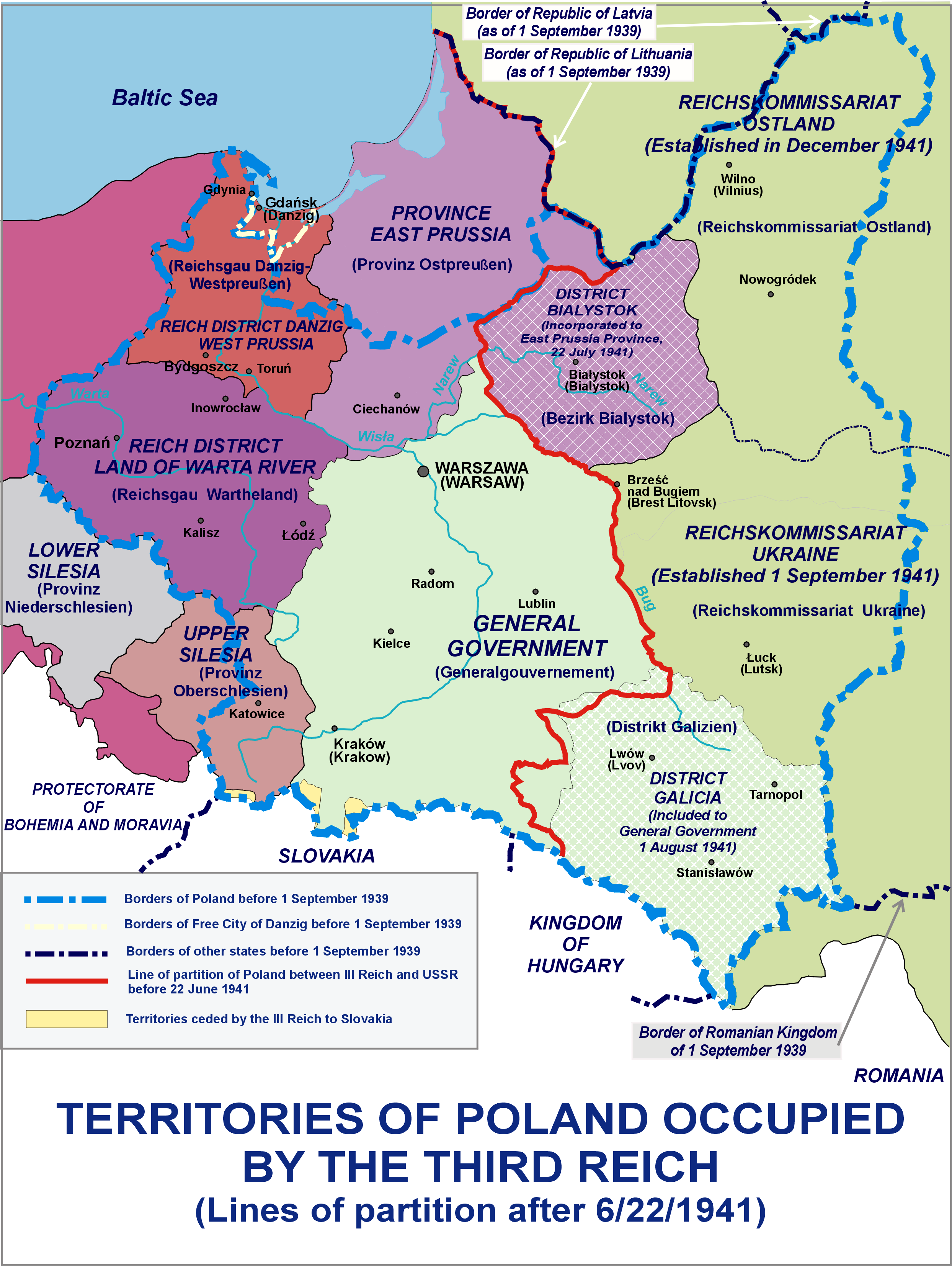
En otoño de 1941 se empezó a llevar a cabo la Aktion Reinhardt, que consistió en la eliminación sistemática de los judíos del Generalgouvernement (desde octubre de 1941 a noviembre de 1943). La Operación Reinhardt fue organizada con 450 alemanes y algunas unidades auxiliares de voluntarios ucranianos. Los campos de exterminio asignados para la Aktion Reinhardt fueron Belzec, Sobibor y Treblinka.
La Operación Reinhardt consiguió eficazmente asesinar a más de dos millones de judíos polacos (hombres, mujeres y niños).
La Solución Final (Endlösung der Judenfrage), la exterminación de los judíos de Europa, fue firmada oficialmente el 20 de enero de 1942 en la famosa Conferencia de Wannsee en Berlín. En el lenguaje oficial se usó “solución final” en lugar de “exterminio”; “traslado” en lugar de “deportación”; “tratamiento especial” en lugar de “matanza con gas”.
En la Conferencia de Wannsee, Eichmann, el funcionario perfecto, entregó una lista que él mismo había redactado con el número de judíos de cada país europeo. Los países se dividían en “A” (países ya ocupados por los alemanes) y “B” (países por ocupar). El total de judíos que era preciso exterminar para que Europa fuera judenfrei era, según Eichmann, de 11 millones.

Lista de Eichmann, 1942
Y del papel, siguiendo la maravillosa eficacia burocracia alemana, se pasó a la acción. 6 millones de judíos fueron masacrados y gaseados. Pero la Solución Final se había puesto en marcha antes de la Conferencia de Wannsee, en septiembre de 1941. ¿A cargo de quién? De los Einsatzgruppen.
Los Einsatzgruppen
La primera fase de la Solución Final (antes de 1942) fue la de las masacres de las comunidades judías, guetos y pueblos enteros. Los Einsatzgruppen (escuadrones de la muerte) estaban formados por miembros de las SS. Su pasión: ejecutar en masa. Se estima que los Einsatzgruppen masacraron 1.300.000 hombres, mujeres y niños. En 1941 había unos 3.000 Einsatzgruppen. Sólo 24 fueron juzgados después de la guerra, en la Einsatzgruppen Trial (1947–48). De esos 24 asesinos, sólo 4 fueron condenados a muerte; el resto recibió penas ridículas.
El 22 de septiembre de 1941, unos pocos Einsatzgruppen masacraron a tiros a 28.000 judíos (hombres, mujeres y niños) en Vínnytsia (Ucrania). Una semana más tarde, el 29 y 30 de septiembre de 1941, se produjo la masacre de Babi Yar (Kiev, Ucrania): 33.771 hombres, mujeres y niños judíos fueron asesinados uno por uno de un tiro en la nuca.
El 30 de noviembre de 1941 y el 8 de diciembre de 1941 los Einsatzgruppen masacraron a 24.000 judíos letones (hombres, mujeres y niños) y a 1.000 judíos alemanes (hombres, mujeres y niños) del gueto de Riga en la masacre de Rumbula (cerca de Riga, Letonia). Steven Springfield había sido enviado a otro gueto, más pequeño, junto a su hermano y se salvó de la masacre. En un vídeo del USHMM recuerda cómo los sádicos soldados alemanes y letones masacraban con placer a los niños y las mujeres:
“I remember while they were taking out those people from the ghetto, I was standing behind the barbed wire and I saw those wild animals, those drunk Latvian and German soldiers beating, killing, in the most brutal and barbaric way. I saw a woman walking with a child, with a baby in her arms, and somehow she slipped and the baby fell out of her arm. The Latvian policeman grabbed the baby, held it by its legs and put a bullet through it, and when the mother started pleading with him and crying, he shot the mother on the spot. I saw that in front… just in front of me. So, when I saw that I had no doubt in my mind what was happening to our people […] People became worse than animals, blood-thirsty, without any pity, any feelings for their fellow human being”[43].
El 14 de octubre de 1942 se produjo la liquidación del gueto de Mizocz: 1.700 judíos (hombres, mujeres y niños) fueron asesinados uno por uno de un tiro en la nuca. Existen unas fotografías espeluznantes de la liquidación del gueto de Mizocz que muestran a las mujeres y niños antes y después de la masacre perpetuada por los Einsatzgruppen / Orpo.

Mujeres desnudas abrazando a sus bebés antes de su ejecución por Einsatzgruppen / Orpo. Masacre de Mizocz, 14 de octubre de 1942 / Instytut Pamieci Narodowej. USHMM

Un Einsatzgruppe / Orpo se dispone a rematar a dos niños aterrorizados que aún están vivos para completar así la ejecución masiva de 1.700 inocentes. Los otros dos Einsatzgruppen / Orpo / policía auxiliar ucraniana se limitan a observar la masacre. Masacre del gueto de Mizocz, 14 de octubre de 1942. Instytut Pamieci Narodowej. USHMM

Un Einsatzgruppe / Orpo remata a las mujeres y niños agonizantes tras la masacre del gueto de Mizocz, 14 de octubre de 1942. Instytut Pamieci Narodowej. USHMM
¿Cómo puede un ser humano disparar contra hombres, mujeres y niños indefensos? ¿Qué tipo de monstruo o de basura es capaz de llevar a cabo semejante atrocidad?
Existe una foto muy famosa de la masacre de Ivangorod, donde casi puede sentirse el miedo de la madre que abraza a su hijita momentos antes de recibir una bala en la cabeza.

Madre judía abrazando a su hija (las niñas llevaban un pañuelito para cubrir sus cabecitas) mientras un Einsatzgruppe le dispara una bala a la cabeza. Masacre de Ivangorod, Ucrania, 1941–1943. Yad Vashem
La fotografía original es más grande y muestra a la derecha a cuatro judíos (dos de ellos niños) acribillados por las balas. Momentos antes, las víctimas habían estado cavando sus propias fosas.
¿Qué fue de todos aquellos asesinos? ¿Dónde están hoy? ¿Se acordarán de los rostros y los cuerpos empapados en sangre, de las miradas de desesperación, súplica y terror de los más pequeñitos, asustados y arropados por sus madres aterrorizadas? Seguramente los pocos asesinos que aún viven no sienten remordimiento alguno. En Shoah, un documental impresionante de 9 horas de Claude Lanzmann, una mujer entrevista a un hombre que participó en una de estas masacres. La entrevistadora le pregunta qué pensaba cuando disparaba a las mujeres y los niños indefensos. Él contesta (en inglés): “Aim carefully”.
Esta fue la primera fase de la Solución Final. Pero tanta sangre podía hacer sufrir a los alemanes (estar disparando a mujeres, niños y bebés podía resultar incómodo), así que era preciso inventar un sistema para exterminar a los judíos y a otros indeseables sin tanta bala en la nuca. Esta preocupación de los alemanes por las ejecuciones en masa y la sangre al estilo Kill Bill es descrita por Hannah Arendt en Eichmann in Jerusalem: A Report on the Banality of Evil.
La segunda fase de la Solución Final fue la de los campos de exterminio y las cámaras de gas. No todas las víctimas fueron judías, pero todos los judíos fueron víctimas, dijo Elie Wiesel. No hay que olvidar que 3.000.000 de polacos no judíos (Poles) fueron también masacrados. Otras víctimas fueron los zíngaros (Roma y Sinti) (c. 220.000), los Testigos de Yehovah (1.200), los homosexuales (5.000-15.000), los prisioneros de guerra soviéticos (c. 2.000.000) y los prisioneros políticos.
De todas maneras, es preciso señalar que la Aktion Reinhardt, la Solución Final y Auschwitz fueron diseñados con el único propósito de exterminar a los judíos de Europa.
La Judenstern
A partir de septiembre de 1939 se fue obligando a los judíos, so pena de muerte, a llevar un distintivo (primero a partir de los 11 años, después a partir de los 6 años, y más tarde a partir de los 2 años) que variaba desde un brazalete blanco a la estrella de David azul o amarilla. La Judenstern empezó simbolizando la vergüenza y acabó significando la deportación y la cámara de gas. La operación, pues, era fácil. Los judíos estaban perfectamente identificados. Sólo faltaba deportarlos y aniquilarlos.

Judenstern de un judío alemán. 1942–1945. USHMM

Niño judío francés con la Judenstern. 1940–1944. USHMM

Dos niños judíos lituanos con la Judenstern: Emanuel Rosenthal (2 años) y Avram Rosenthal (5 años) en el gueto de Kovno. Los 1.300 niños del gueto de Kovno fueron asesinados de un tiro o deportados y gaseados. Emanuel y Avram Rosenthal fueron deportados a Majdanek y gaseados. Gueto de Kovno, 1944. USHMM
¿Qué fue de los millones de alemanes y austríacos que abrazaron el nazismo e hicieron posible el Holocausto? ¿Dónde están hoy?
En 1920, el Partido Nazi contaba tan solo con 600 miembros. En 1945, con 8.500.000. En 1942, el 90% de los alemanes (según Yehuda Bauer, uno de los mejores historiadores del Holocausto) apoyó el nazismo y colaboró feliz en las humillaciones y masacres de los judíos. ¿Qué fue de todos ellos? ¿Recibieron su castigo? ¿Fueron acaso enjuiciados y condenados por sus crímenes y su complicidad con el Holocausto? ¿Dónde está hoy el millón de SS que mató, masacró y gaseó a millones de inocentes? ¿Dónde están hoy los 7.000 SS que trabajaron eficazmente en Auschwitz? ¿Pagaron los culpables las atrocidades que cometieron? Casi todos murieron libres o siguen viviendo libres, viejitos y felices.
Hay que ser muy frío de cabeza para no desear poner a todos esos asesinos en una gran cámara de gas. ¿Nos convertiría ello en nazis? No. Los nazis mataron a millones de inocentes. Aquí se condenaría a muerte a asesinos monstruosos que masacraron a niños, mujeres y hombres. He de reconocer que esto me produce una gran contradicción, puesto que siempre he estado en contra de la pena de muerte. En Israel no existe la pena de muerte, salvo para ex-nazis. Defender la pena de muerte sólo para los casos de genocidio y asesinato en masa (mass murder) es tema para debate, pero no me parece una mala opción. Los crímenes de los nazis han sido los más atroces de la historia de la humanidad. Woody Allen dice en Anything Else en boca de David Dobel: “The crimes of the Nazis were so enormous that if the entire human race were to vanish as a penalty, it could be argued as justifiable“. De todas maneras, matar a los verdugos no nos devolvería a todos aquellos millones de hombres, mujeres y niños masacrados y gaseados. Por ello me contentaría con una prisión llena de mierda para todos los ex-nazis.
La impunidad de los asesinos es un insulto a todas las víctimas masacradas y gaseadas, y da rienda suelta a nuevos genocidios. La historia de la humanidad es triste, cruel e injusta: a mayor el crimen, menor el castigo. Los dioses, las hadas y los unicornios no castigan, y los asesinos con las manos manchadas de sangre duermen plácidamente sin recordar los gritos de sus víctimas.
Wiesel afirma que olvidar a las víctimas es volver a matarlas: “L’oubli signifierait danger et insulte. Oublier les morts serait les tuer une deuxième fois“[45]. Es verdad que el juicio contra los culpables no resucitará a los muertos. Pero la impunidad de los culpables ¿no es acaso escupir sobre el sufrimiento de las víctimas?
Tanto en Alemania como en Austria la gente de mi generación que aún tiene abuelos acarrea un pasado familiar sangriento. Han pasado tan sólo 74 años desde la Solución Final. En 1942, muchos de los SS (Schutzstaffel), SA (Sturmabteilung) y Einsatzgruppen apenas tenían 20 años. La gran mayoría de ancianos y ancianas de 94 años para delante que se ven hoy pasear por las calles de Berlín comiendo un bratwurst o en los Cafés de Viena disfrutando de un Sacher-Torte mit Schlag denunció, humilló, y/o masacró a judíos voluntaria y convencidamente. ¿Han sido juzgados por ello? En absoluto. No han sido juzgados ni por los hombres ni, posiblemente, por Dios.
La justicia, como es sabido, apenas se hace oír tras la barbarie. La mayoría de los pocos miembros de las SS, SA y los Einsatzgruppen que fueron juzgados recibieron penas cortísimas[46]. La inmensa mayoría de los médicos del macabro Programa Eutanasia permaneció impune. Muchos médicos responsables del asesinato de miles de bebés, niños y adultos siguieron ejerciendo como médicos después de la guerra. Roba y serás encarcelado. Mata a miles de inocentes y serás perdonado.
En mi opinión, Auschwitz y el Holocausto son doblemente horribles: primero; porque las atrocidades fueron abominables y apenas nadie hizo nada para evitarlas. Y, segundo, porque los culpables apenas fueron castigados, y eso dio carta blanca para nuevos genocidios y nuevas atrocidades (Vietnam, Bosnia, Ruanda, Israel-Palestina, Irak, Sudán, Siria…). Lo único que la Segunda Guerra Mundial enseñó al hombre (después de 72 millones de muertos, medio mundo arrasado y la destrucción de todos los valores morales) es que los genocidios son facilísimos de llevar a cabo. Y lo único que la justicia de posguerra enseñó al hombre es que los responsables de los genocidios apenas tuvieron su castigo y que los genocidios seguirán repitiéndose.
¿Los verdugos y colaboradores del Holocausto que salieron impunes llevaron su castigo en su conciencia? ¿Les atormentaron y siguen atormentándoles las humillaciones, torturas y masacres que perpetraron, los llantos de los bebés, los gritos de los niños, el recuerdo de las hombres y mujeres bañados en sangre, la insumisión de las víctimas caminando hacia las cámaras de gas o preparando sus fosas antes de ser ejecutadas, y las fosas rebosando de cadáveres? Para el monstruo que ha sido capaz de cometer tales crímenes es raro que exista el arrepentimiento.
¿Los alemanes y austríacos sabían lo que estaba pasando? Posiblemente no conocían las cámaras de gas, pero la humillación, tortura y asesinato de judíos desde luego que sí los conocían. Primo Levi cita a Eugen Kogon, superviviente de Buchenwald, el cual en su libro Der SS Staat escribe: “no había un alemán que no supiese de la existencia de los campos (…) Todos los alemanes eran testigos de la multiforme barbarie antisemita: millones de ellos habían presenciado, con indiferencia o con curiosidad, con desdén o quizá con maligna alegría, el incendio de las sinagogas o la humillación de los judíos y judías obligados a arrodillarse en el fango de la calle”[47]. ¿Y qué hacían los alemanes ante tales injusticias? Alzaban su brazo derecho y gritaban eufóricos Heil Hitler!
La solución barata de la justicia tras el Holocausto
Una solución barata a la culpabilidad del Holocausto fue hacer creer al mundo que los únicos culpables habían sido cuatro alemanes y un puñado de sádicos, que, absolutamente solos, fueron capaz de aniquilar a 11 millones de seres humanos. Y eso es lo que la Alemania de hoy quiere hacer creer a las nuevas generaciones y al mundo entero. ¡Los pobres alemanes sólo cumplían órdenes que venían de arriba y los pobres austríacos fueron invadidos! Yehuda Bauer afirma en su brillante libro Rethinking the Holocaust que en 1942 el 90% del alemán común apoyó y colaboró feliz y convencido en las humillaciones y masacres de los judíos.
El hombre es libertad. El hombre es completamente responsable de sus actos, y nadie, ni siquiera Dios, le salva de su culpabilidad por la sangre que ha derramado. Sartre dice en boca de Hugo en Les mains sales que el hombre que mata es siempre culpable de matar aunque haya cumplido una orden que venía de arriba, puesto que hay un momento en que la orden queda atrás y lo único que existe es la propia decisión: “L’ordre est resté en arrière et je m’avançais seul et j’ai tué seul“[48].
¿Y dónde estuvo Dios?
El ser humano se ha preguntado después de Auschwitz si Auschwitz fue un problema de antropodicea o de teodicea. Frankl ve en Auschwitz un problema más bien de antropodicea que de teodicea. Según Sartre, el mal es fruto siempre de la libertad humana, no porque Dios sea bueno, sino porque, simplemente, no existe. El hombre escoge el mal y escoge el bien, solo y sin Dios, y no hay nada ni nadie que pueda justificar sus acciones.
Primo Levi escribe: “Hemos viajado hasta aquí en vagones sellados; hemos visto partir hacia la nada a nuestras mujeres y a nuestros hijos; convertidos en esclavos hemos desfilado cien veces ida y vuelta al trabajo mudo, extinguida el alma antes de la muerte anónima. No volveremos. Nadie puede salir de aquí para llevar al mundo, junto con la señal impresa en la carne, las malas noticias de cuanto en Auschwitz ha sido el hombre capaz de hacer con el hombre”[44].
Primo Levi denuncia los pequeños agradecimientos personales a Dios en medio de tanto horror e injusticia: “… desde mi litera que está en el tercer piso, se ve y se oye que el viejo Kuhn reza, en voz alta, con la gorra en la cabeza y oscilando el busto con violencia. Kuhn da las gracias a Dios porque no ha sido elegido. Kuhn es un insensato. ¿No ve, en la litera de al lado, a Beppo el Griego que tiene veinte años y pasado mañana irá al gas, y lo sabe, y está acostado y mira fijamente a la bombilla sin decir nada y sin pensar en nada? ¿No sabe Kuhn que la próxima vez será la suya? ¿No comprende Kuhn que hoy ha sucedido una abominación que ninguna oración propiciatoria, ningún perdón, ninguna expiación de los culpables, nada, en fin, que esté en poder del hombre hacer podrá remediar ya nunca? Si yo fuese Dios, escupiría al suelo la oración de Kuhn[30]“.
Yo nunca he creído en Dios, pero, si creyera en él, no escupiría al suelo la oración de Kuhn, sino que le escupiría a Dios en la cara, y le diría: ¿Cómo duermes, dios de pacotilla, con los gritos de millones de hombres, mujeres y niños inocentes masacrados y gaseados?
Según Frankl, la pregunta correcta no es ¿dónde estaba Dios? sino más bien ¿dónde estaba el hombre? Lo cierto, pienso yo, es que Auschwitz fue permitido por el hombre y permitido por Dios. Y ni el hombre ni Dios fueron castigados por ello. La Historia nos ha enseñado (y nos muestra cada día) que un sinfín de holocaustos son posibles.
Después del Holocausto, nadie resultó ser culpable del horror: casi todos escaparon de la culpa y la responsabilidad: la gran mayoría de los SS, SA y Einsatzgruppen no fueron responsables ni culpables, y el alemán y austríaco común que colaboró feliz en la humillación, tortura y asesinato de millones de hombres, mujeres y niños tampoco fue responsable ni culpable. Eichmann no fue responsable ni culpable (¡él sólo era un funcionario alemán que cumplía órdenes! Si le hubieran ordenado matar a su padre lo hubiera hecho sin dudar, confesó Eichmann en su juicio), y, por supuesto, Dios tampoco fue ni responsable ni culpable.
¿Justicia hipócrita o una prisión llena de mierda para todos los ex-nazis?
¿Qué castigo hubiera sido apropiado para Alemania y Austria acorde a sus crímenes contra la humanidad? Primero, condenar a todos los culpables. Y cuando digo culpables me refiero a todos aquellos que fueron una pieza indispensable en la maquinaria gigantesca que hizo posible el Holocausto. Hablo de millones. Para todos los SS, la horca. Para todos los colaboradores y los seguidores del nazismo, la cárcel. Pero aún es poco si recordamos Auschwitz. Segundo, recordar siempre lo que Alemania y Austria hizo. Alemania y Austria están disfrazadas hoy de países ecologistas y civilizados, pero hace sólo 75 años estaban gaseando a millones de hombres, mujeres y niños. Eso no hay que olvidarlo jamás. Cualquier alemán y cualquier austríaco que se sienta hoy orgulloso de ser alemán o austríaco debe ser crítico con la historia de su país. La única posición coherente que le queda es el anti-nazismo, al anti-antisemitismo y el anti-racismo.
Pero los alemanes y los austríacos de hoy a lo máximo se sienten incómodos cuando se habla del Holocausto, y prefieren mirar hacia otro lado. Que se sientan incómodos. Gasear a hombres, mujeres y niños no resulta placentero para los oídos de hoy. Cuando se descubrieron en los campos liberados los crematorios, los supervivientes esqueléticos y las pilas gigantescas de cadáveres, la mayoría de la gente calló, miró hacia otro lado, se santiguó y olvidó.
Alemania y Austria aún no han pagado sus crímenes contra la humanidad. Hoy son dos superpotencias con poca memoria histórica, apenas remordimiento y prepotentes a más no poder. Wiesel escribe en la primera versión de La nuit que 10 años después de Buchenwald el mundo ha olvidado ya la barbarie. Los verdugos siguen vivos y los criminales de guerra se pasean tranquilamente por las ciudades alemanas: “Et maintenant, dix ans après Buchenwald, je me rends compte que le monde oublie. L’Allemagne est un État souverain. L’armée allemande est ressuscitée. Ilse Koch, la femme sadique de Buchenwald a des enfants et elle est heureuse. Des criminals de guerre se promènent dans les rues de Hambourg et Münich“[49].
Ambos países (Alemania y Austria), protestante el uno, católico el otro, rebosan de neandertales ultraderechistas y capullos neo-nazis con el cerebro inundado de mierda y de cerveza. Hoy la víctima no es el judío. La víctima es el musulmán y el inmigrante. Lo importante es tener un enemigo al que culpar de las propias desgracias.
Recordando a los niños de The Auschwitz Album me parece justo decir que Alemania y Austria deberían colgar a todos sus SS, encarcelar a todos aquellos que apoyaron el nazismo y pagar una deuda a todos los países de las víctimas exterminadas (Israel, Polonia, Rusia, Hungría, Rumanía, Eslovaquia, República Checa, Francia, España, Grecia, Inglaterra, Holanda, Bélgica, etc, etc, etc…) hasta el momento del Big Crunch.
¿Acaso resultan duras estas sentencias? Veamos de nuevo Saul fia, escuchemos a los niños, mujeres y hombres gritar de horror en las cámaras de gas y nos daremos cuenta de que son sentencias leves. Los que han visitado Auschwitz después de la guerra han podido ver las infinitas marcas de uñas que dejaron las víctimas en esos largos minutos de agonía.
Cada día me enfrento en internet con neandertales neo-nazis que escupen sobre la memoria de las víctimas del Holocausto. Yo no me quedo callada, y pierdo mi tiempo contestando a sus insultos y pidiendo una prisión llena de mierda y vómito para todos los ex-nazis. Los pobres se alteran y me insultan y me llaman judía bolchevique, o musulmana o inmigrante. No soy ni judía ni musulmana y mucho menos bolchevique. ¿Inmigrante? Considero que nadie es inmigrante en este planeta que es de todos. Los burros aún no se han enterado de que no es necesario ser judío para condenar Auschwitz; sólo es necesario ser humano.
Después del Holocausto ha habido genocidios, sí, pero, como bien apunta Yehuda Bauer, ninguno es comparable al Holocausto (aún). Por ahora no se han vuelto a transportar a seres humanos en vagones de animales ni se ha vuelto a gasear con Zyklon B a millones de hombres, mujeres y niños. Pero eso no quiere decir que no puedan volver a repetirse.
Que vengan más genocidios. Que vengan. Los verdugos apenas serán castigados. Los niños perecerán y los asesinos morirán viejitos y felices. Se cuenta que Hitler dijo a propósito de la exterminación de los judíos y un posible castigo para Alemania algo como: “¿Quién recuerda hoy la masacre de los armenios?”. Y en efecto: Turquía aún no ha sido oficialmente condenada por la matanza de 1.500.000 hombres, mujeres y niños armenios en la Primera Guerra Mundial. Y cuando venga otro genocidio, los verdugos dirán: ¿pero quién culpó a los alemanes que fueron obligados a ser nazis y a los austríacos que fueron invadidos?
La justicia apesta. El mundo rebosa de neo-nazis patéticos y de racistas de mierda, y Auschwitz empieza a estar pasado de moda. Pero se seguirán oyendo, por millones de años, los gritos de los hombres, mujeres y niños que perecieron, gracias al hombre común, en los guetos, los barrancos y las cámaras de gas. En 1942, el 90% de los alemanes colaboró feliz en la humillación, deportación y masacre de los judíos. ¿Qué ha sido de ellos? ¿Dónde están ahora? Una prisión llena de mierda para todos los ex-nazis, bitte.
 Antonia Tejeda Barros, Madrid, 20 de marzo de 2016

Niños supervivientes saliendo de sus barracas. Auschwitz, 1945. Cortesía del USHMM

Niños supervivientes. Auschwitz, 1945. Belarusian State Archive of Documentary Film and Photography. Cortesía del USHMM
Créditos
Auschwitz-Birkenau State Museum
United States Holocaust Memorial Museum (USHMM)
Yad Vashem. The World Holocaust Remembrance Center
Los Angeles Museum of the Holocaust (LAMOTH)
Guetto Fighters’ House Museum
Center for Holocaust & Genocide Studies (University of Minnesota): Because They Were Jews! by David Friedman
Bibliografía
Arendt, Hannah. Eichmann in Jerusalem. A Report on the Banality of Evil. USA: Penguin Classics, 2006 (1977), pp. vii–312
Borowski, Tadeusz. This Way for the Gas, Ladies and Gentlemen (trad. Barbara Vedder). New York & London: Penguin Classics, 1976 (1967), pp. 9–180
Chare, Nicholas & Williams. Dominic. “How Documents Buried by Jewish Prisoners at Auschwitz Tell the Story of Genocide“. Slate, 3 de febrero de 2006
Dobrowlska, Anna. The Auschwitz Photographer (trad. Anna Samborska & Clay Young). Warsaw: Rekontrplan, 2013, pp. 5–282
Frankl, Viktor E. … trotzdem Ja zum Leben sagen. Ein Psychologe erlebt das Konzentrationslager. München: Kösel, 2014 (2009), pp. 7–191
Frankl, Viktor E. Man’s Search for Meaning (trad. Ilse Lasch). Boston: Beacon, 2006, pp. ix–165
Frankl, Viktor E. El hombre en busca de sentido (trad. Christine Kopplhuber y Gabriel Insauti Herrero). Barcelona: Herder, 2004 (1979), pp. 9–153
‘Ha-Elion, Moshe. En los Kampos de la Muerte. Israel: Instituto Maale Adumim, 2000, pp. 5–94
Levi, Primo. Se questo è un uomo. Torino: Einaudi, 2014 (1958), pp. 3–219
Levi, Primo. Si esto es un hombre (trad. Pilar Gómez Bedate). Barcelona: Austral-El Aleph, 1998 (1987), pp. 7–222
Müller, Filip. Eyewitness Auschwitz. Three Years in the Gas Chambers (trad. Susanne Flatauer). Chicago: Ivan R. Dee & USHMM,1999, pp. ix–180
Niewyk, Donald & Nicosia, Francis. The Columbia Guide to the Holocaust. USA: Columbia University Press, 2000, pp. xi–473
Sartre, Jean-Paul. Les mains sales. France: Gallimard, 2007 (1948), pp. 13–247
Reiniger, Franziska. “Inside the Epicenter of the Horror – Photographs of the Sonderkommando“. Yad Vashem
Roccas, Ronis. “We did the dirty work of the Holocaust’: Sonderkommando Auschwitz“. haArez, 2 de mayo del 2000
Venezia, Shlomo. Sonderkommando. Dans l’enfer des chambres à gaz. Paris: Albin Michel, 2007, pp 7–249
Weiss, Martin. “Selection at Auschwitz“. USHMM
Wiesel, Elie. La nuit. France: Les éditions de minuit, 2012 (1958), pp. 9–199
Wiesel, Elie. “Message from Elie Wiesel“. Auschwitz-Birkenau State Museum
NOTAS
[1] Venezia, Sonderkommando. Dans l’enfer des chambres à gaz, p. 87
[2] Wiesel, La nuit, “Préface de 2007”, p. 13
[3] Moshe Ha’Elion (nacido en 1925), judío griego, fue deportado a Auschwitz en 1943. Tenía 18 años. Después de la marcha de la muerte estuvo en Mauthausen, Melk y Ebensee. En מיצרי שאול (traducido al inglés como Straits of Hell) y En los Kampos de la Muerte (colección de tres poemas escritos en ladino) Moshe narra los horrores de la deportación y de los campos de concentración y exterminio nazis. Fue el prisionero número 114.923. Vive en Israel y tiene 91 años
[4] Viktor Frankl (1905–1997), judío austríaco, psiquiatra y filósofo, sobrevivió a los horrores de Theresienstadt, Auschwitz, Kaufering y Türkheim (dos subcampos de Dachau). Fundador de la logoterapia (una terapia basada en la búsqueda por el sentido), en Ein Psychologe erlebt das KZ narra las experiencias en los campos “pequeños” de concentración nazis. El libro fue luego retitulado …trotzdem Ja zum Leben sagen. Ein Psychologe erlebt das Konzentrationslager. Traducido al inglés en 1959 primeramente bajo el título From Death-Camp to Existentialism, fue luego titulado con el nombre que hoy se conoce: Man’s Search for Meaning (la edición española usó este último título: El hombre en busca de sentido)
[5] Tadeusz Borowski (1922–1951) ganó la “beca Hitler” a los 21 años por ser polaco y sobrevivió a los horrores de Auschwitz, Natzweiler-Struthof y Dachau. Dachau fue liberado el 1 de mayo de 1945, cuando Borowski tenía 22 años y medio. En 1947 publicó 5 historias cortas bajo el título Pożegnanie z Marią –Adiós a María– (publicado en inglés bajo el título This Way for the Gas, Ladies and Gentlemen –título de una de las historias–). Cuatro años más tarde, el 1 de julio de 1951, se suicidó. ¿Y cómo lo hizo? Nada menos que inhalando gas. Su mujer acababa de dar a luz 3 días antes
[6] Shlomo Venezia (1923–2012), judío griego, fue deportado a Auschwitz en marzo de 1944; tenía 22 años. Fue Sonderkommando en los Crematorios II y III de Auschwitz-Birkenau. Después de la marcha de la muerte, fue deportado a Mauthausen, Melk y Ebensee. Su hermano Maurice Venezia (nacido en 1921) fue también Sonderkommando, sobrevivió y hoy tiene 95 años. Venezia publicó en el 2007 en francés un testimonio espeluzante y de enorme valor titulado Sonderkommando. Dans l’enfer des chambres à gaz, traducción de una serie de entrevistas en italiano realizadas en el 2006 en Roma por Beatrice Prasquier (con la ayuda de Marcello Pezzetti). Venezia dedicó su vida a dar testimonio sobre los horrores de Auschitz. Murió a los 88 años en Roma
[7] Primo Levi (1919–1987), judío italiano, fue deportado a Auschwitz en marzo de 1944. Tenía 25 años. En Se questo è un uomo narra la vida en Auschwitz III. Fue el prisionero número 174.517. Completan la llamada “Trilogía de Auschwitz” La tregua y I sommersi e i salvati. Otro testimonio interesantísimo es Così fu Auschwitz. Testimonianze 1945-1986 (con Leonardo De Benedetti)
[8] Elie Wiesel (1928), judío rumano nacionalizado norteamericano, fue deportado a Auschwitz el 6 de mayo de 1944; tenía 15 años. Después de la marcha de la muerte fue prisionero en Buchenwald hasta la liberación (11 de abril de 1945). Wiesel aparece en la famosa fotografía de los prisioneros en una barraca de Buchenwald. En La Nuit (publicado primeramente en yiddish bajo un título mucho más significativo: Un di Velt Hot Geshvign –Y el mundo permaneció callado– narra los horrores de la deportación, Auschwitz y la marcha de la muerte. En 1986 obtuvo el Premio Nobel de la Paz. Fue el prisionero número A-7713. Vive en EEUU y tiene 86 años

Buchenwald, 16 de abril de 1945. Wiesel es el 7º prisionero de la segunda fila
[9] Nacido en Trutnov (Checoslovaquia) en 1930. En diciembre de 1942, Michal fue enviado junto a su familia a Hradec Kralove y de allí fue deportado a Theresienstadt. El 15 de diciembre de 1943 Michal y su familia fueron deportados a Auschwitz-Birkenau. Michal fue tatuado con el número 168.497, su padre con el número 168.496 y su madre con el número 71.253. Durante seis meses pudieron estar juntos en el “campo familiar”. En junio de 1944 su madre fue enviada a Stutthof (murió en el campo en enero de 1945); su padre fue gaseado el 11 de julio de 1944. Michal sobrevivió Auschwitz, Mauthausen, Melk y dos marchas de la muerte. En 1945–47 escribió su diario (tres libretas) sobre la ocupación nazi en Checoslovaquia y los campos de exterminio.
[10] Levi, Se questo è un uomo, p. 68
[11] Message from Elie Wiesel
[12] USHMM
[13] David Olère (1902–1985) fue un Sonderkommando superviviente de Auschwitz-Birkenau que trabajó en el Crematorio III. Pintor e ilustrador judío polaco, se mudó a París en 1923. Fue deportado a Auschwitz el 2 de marzo de 1943. Después de Auschwitz, sobrevivió la marcha de la muerte, Mauthausen, Melk y Ebensee. Plasmó los horrores que presenció en Auschwitz en sus dibujos y cuadros
[14] Venezia, Sonderkommando. Dans l’enfer des chambres à gaz, p. 86
[15] Venezia, Sonderkommando. Dans l’enfer des chambres à gaz, p. 86
[16] David Friedman (1893–1980) (Friedmann, con dos “Ns”, antes de 1960, año en que obtuvo la nacionalidad norteamericana) fue un superviviente de Auschwitz. Nació en Mährisch Ostrau. Pintor, ilustrador y violinista, vivió en Berlín de 1911 a 1938. En diciembre de 1938 emigró a Praga con su mujer Mathilde y su hija Mirjam Helene. En 1941 los tres fueron deportados al guetto de Lodz, y en 1944, a Auschwitz, donde su mujer y su hija fueron gaseados. Gracias a su talento como violinista, Friedman fue transferido al subcampo Gleiwitz I. Sobrevivió a la marcha de la muerte y llegó al campo de Blechhammer, el cual fue liberado por el Ejército Rojo en 1945. Estuvo en Cracovia y Praga, donde pintó muchos cuadros sobre los horrores del Holocausto. Friedman y su segunda mujer, Hildegard, emigraron a Israel en 1949. Tuvieron una hija llamada también Miriam y emigraron a EEUU en 1954. Su hija Miriam Friedman Morris lucha por recuperar los cuadros de su padre y por mantener viva su memoria
[17] Venezia, Sonderkommando. Dans l’enfer des chambres à gaz, p. 94
[18] Borowski, This Way for the Gas, Ladies and Gentlemen, p. 39
[19] Ha-Elion, “La djovenika al lager”, En los Kampos de la Muerte, p. 15
[20] Borowski, This Way for the Gas, Ladies and Gentlemen, p. 36
[21] Primo Levi, Si esto es un hombre, p. 15 [“vagoni merci, chiusi dall’esterno, e dentro uomini donne bambini, compressi senza pietà … in viaggio verso il nulla“, Primo Levi, Se questo è un uomo, p. 9]
[22] Borowski, This Way for the Gas, Ladies and Gentlemen, p. 37
[23] Frankl, El hombre en busca de sentido, p. 39 [“Uns, der Transportminorität von damals, wurde es am Abend des gleichen Tages bekannt. Ich fragte Kameraden, die schon länger im Lager waren, wohin mein Kollege und Freund P- gekommen sein mochte. ‘Ist er auf die andere Seite geschickt worden?’ ‘Ja’, sage ich. ‘Dann siehst du ihn dort’, sagt man mir. Wo? Eine Hand zeigt zu einem wenige hundert Meter entfernten Schlot, aus dem eine viele Meter hohe Art Stichflamme unheimlich in den weiten, grauen polnischen Himmel emporzüngelt, um sich in eine düstere Rauchwolke aufzulösen“], Frankl, … trotzdem Ja zum Leben sagen, pp. 30–31
[24] Weiss: “Selection at Auschwitz“. USHMM
[25] “La solidarité n’existait que quand on avait assez pour soi; autrement, pour survivre, il fallait être égoïste“, Venezia, Sonderkommando. Dans l’enfer des chambres à gaz, p. 137
[26] Roccas, ‘We did the dirty work of the Holocaust’: Sonderkommando Auschwitz, haArez, 2 de mayo del 2000
[27] Borowski, This Way for the Gas, Ladies and Gentlemen, p. 37
[28] Levi, Si esto es un hombre, p. 134. “La selezioni si sentono arrivare. ‘Selekcja’: la ibrida parola latina e polacca si sente una volta, due volte, molte volte, intercalata in discorsi stranieri“, Levi, Se questo è un uomo, p. 121
[29] Levi, Si esto es un hombre, pp. 138, 139. “Ognuno di noi, che esce nudo dal Tagesraum nel freddo dell’aria di ottobre, deve fare si corsa i pochi passi fra le due porte davanti ai tre, consegnare la scheda alla SS e rientrare per la porta del dormitorio. La SS, nella frazione di secondo fra due passaggi successivi, con uno sguardo di faccia e di schiena giudica della sorte di ognuno, e consegna a sua volta la scheda all’uomo alla sua destra o all’uomo alla sua sinistra, e questo è la vita o la morte di ciascuno di noi“, Levi, Se questo è un uomo, p p. 123
[30] Levi, Si esto es un hombre, p. 141; “dalla mia cuccetta che è al terzo piano, si vede e si sente che il vecchio Kuhn prega, ad alta voce, col berretto in testa e dondolando il busto con violenza. Kuhn ringrazia Dio perché non è stato scelto. Kuhn è un insensato. Non vede, nella cuccetta accanto, Beppo il greco che ha vent’anni, e dopodomani andrà in gas, e lo sa, e se ne sta sdraiato e guarda fisso la lampadina senza dire niente e senza pensare piú niente? Non sa Kuhn che la prossima volta sarà la sua volta? Non capisce Kuhn che è accaduto ogii un abominio che nessuna preghiera propiziatoria, nessun perdono, nessuna espiazione dei colpevoli, nulla insomma che sia in potere dell’uomo di fare, potrà risanare mai piú? Se io fossi Dio, sputerei a terra la preghiera di Kuhn“, Levi, Se questo è un uomo, p. 127
[31] En Venezia, Sonderkommando. Dans l’enfer des chambres à gaz, pp. 205–235
[32] Primo Levi, Si esto es un hombre, p. 35 [“La morte incomincia dalle scarpe“, Primo Levi, Se questo è un uomo, p. 27]
[33] Primo Levi, Si esto es un hombre, p. 53 [“… tutti sentiamo che questa musica è infernale“, Primo Levi, Se questo è un uomo, p. 44]
[34] Primo Levi, Si esto es un hombre, p. 37 [“Tale sarà la nostra vita. Ogni giorno, secondo il ritmo prestabilito, Ausrücken ed Einsrücken, uscire e rientrare; lavorare, dormire e mangiare; ammalarsi, guarire o morire“, Primo Levi, Se questo è un uomo, p. 28 ]
[35] Primo Levi, Si esto es un hombre, p. 80 [“Ma come si potrebbe pensare di non aver fame? il Lager è la fame: noi stessi siamo la fame, fame vivente“, Primo Levi, Se questo è un uomo, p. 69]
[36] “[Moll] m’a donné un coup tout en me faisant un croche-pied pour que je tombe. Il fallait se relever immédiatement, sinon la punition était plus dure encore. Il m’a frappé une deuxième fois, je suis retombé et me suis relevé“, Venezia, Sonderkommando. Dans l’enfer des chambres à gaz, p. 125
[37] Primo Levi, Si esto es un hombre, p. 39 [“La confuzione delle lingue è una componente fondamentale del modo di vivere di quaggiú; si è circondati da una perpetur Babele, in cui tutti urlano ordini e minacce in lingue mai prima udite, e guai a chi non afferra a volo. Qui nessuno ha tempo, nessuno ha pazienza, nessuno ti dà ascolto“, Primo Levi, Se questo è un uomo, p. 30]
[38] Borowski, “This Way for the Gas, Ladies and Gentlemen”, en This Way for the Gas, Ladies and Gentlemen, p. 32 (nota a pie de página)
[39] Primo Levi, Si esto es un hombre, pp. 98, 99 [“La loro vita è breve ma il loro numero è sterminato; sono loro, i Muselmänner, i sommersi, il nerbo del campo; loro, la massa anonima, continuamente rinnovata e sempre identica … già troppo vuoti per soffrire veramente“, Primo Levi, Se questo è un uomo, p. 86]
[40] Primo Levi, Apéndice de 1976, Si esto es un hombre, pp. 215–216 [“Qui non c’era solo la morte, ma una folla di dettagli maniaci e simbolici, tutti tesi a dimostrare e confermare che gli ebrei, e gli zingari, e gli slavi, sono bestiame, strame, immondezza. Si ricordi il tatuaggio di Auschwitz, che imponeva agli uomini il marchio che si usa per i buoi; il viaggio in vagoni bestiame, mai aperti, in modo da costringere i deportati (uomini, donne e bambini!) a giacere per giorni nelle proprie lordure; il numero di matricola in sostituzione del nome; la mancata distribuzione di cucchiai (eppure i magazzini di Auschwitz, alla liberazione, ne contemevano quintali), per cui i prigioneri avrebbero dovuto lambire la zuppa come cani; l’empio sfruttamento dei cadaveri, trattati come una qualsiasi anonima materia prima, da cui si ricavavano l’oro dei denti, i capelli come materiale tessile, le ceneri come fertilizzanti agricoli; gli uomini e le donne degradati a cavie, su cui sperimentare medicinali per poi sopprimerli“, Primo Levi, “Appendice”, Se questo è un uomo, p. 187]
[41] Frankl, El hombre en busca de sentido, p. 113. Und Schritt für Schritt, nicht anders, trittst du ein in dieses neue Leben, wirst du wieder Mensch, Frankl, … trotzdem Ja zum Leben sagen, p. 135
[42] [“Se nos planteó la cuestión: ¿qué hacemos con las mujeres y los niños? Decidí que debía encontrar una solución final. Pues no me pareció que se justificara exterminar –quiero decir matar u ordenar que mataran– a los hombres, y dejar a los niños que crezcan y se venguen contra nuestros hijos y nuestros nietos. Había que adoptar la difícil decisión de conseguir que esa gente desapareciera de la faz de la Tierra”], Himmler, Segundo discurso de Posen, 6 de octubre de 1943
[43] Springfield, vídeo entrevista de 1990. USHMM
[44] Levi, Si esto es un hombre, p. 59. “Noi abbiamo viaggiato fin qui nei vagoni piombati; noi abbiamo visto partire verso il niente le noestre donne e i nostri bambini; noi fatti schiavi abbiamo marciato cento volte avanti e indietro alla fatica muta, spenti nell’anima prima che dalla morte anonima. Noi non ritorneremo. Nessuno deve uscire di qui, che potrebbe portare al mondo, insieme col segno impresso nella carne, la mala novella di quanto, ad Auschwitz, è bastato animo all’uomo di fare dell’uomo“, Levi, Se questo è un uomo, p. 49
[45] Wiesel, La Nuit, “Préface”, p. 23
[46] En los Juicios de Dachau (The Dachau Trials), el Juicio del Alto Comando (The High Command Trial) y el Juicio de los Einsatzgruppen (The Einsatzgruppen Trial) se juzgaron a varios asesinos, responsables de masacres abominables y de crímenes contra la humanidad. A modo de ilustración, algunos casos escandalosos fueron las penas imputadas a Georg von Küchler, Hermann Hoth, Georg-Hans Reinhardt, Karl-Adolf Hollidt, Hermann Reinecke, Walter Warlimon y Otto Wöhler, acusados en el Juicio del Alto Comando, 1948, de crímenes de guerra y de crímenes contra la humanidad por participar en órdenes de asesinato, tortura, deportación y captura de civiles en territorios ocupados. Las penas fueron de 20 de años de prisión para von Küchler (en 1951 se redujo a 12 años de prisión, y en 1953 fue absuelto), 15 años para Hoth (absuelto en 1954), 15 años para Reinhardt (absuelto en 1952), 5 años para Hollidt (absuelto al cabo de 1 año), prisión de por vida para Reinecke (absuelto en 1954), prisión de por vida para Warlimon (reducida a 18 años de prisión en 1951 y absuelto en 1954) y de 8 años de prisión para Wöhler (absuelto en 1951). En esta línea, cabe destacar el Juicio de los Einsatzgruppen, 1948, donde se juzgó a 24 miembros de los Einsatzgruppen: a 22 se les culpó de tres puntos gravísimos: 1. Crímenes contra la humanidad: persecución política, racial y religiosa, asesinato, exterminio, prisión y otros actos inhumanos cometidos en contra de civiles, como parte de un organizado plan de genocidio; 2. Crímenes de guerra; 3. Miembros de organizaciones criminales: SS, SD y Gestapo: 4 fueron sentenciados a muerte y ahorcados, 9 fueron sentenciados a muerte pero finalmente cumplieron condenas de tan sólo 6, 8 y 10 años, uno fue sentenciado a prisión de por vida pero sólo cumplió condena de 10 años, tres fueron sentenciados a 10 años (dos cumplieron condenas de sólo 4 y 6 años, y el otro fue absuelto), dos fueron sentenciados a 10 años (uno cumplió 8 años y el otro fue absuelto), dos fueron absueltos tras el juicio y uno se suicidó
[47] Citado en Levi, “Apéndice de 1976”, Si esto es un hombre, p. 197
[48] Sartre, Les mains sales, p. 22
[49] Wiesel, La nuit, “Préface” (2007), p. 17. Ilse Koch, llamada “la bruja de Buchenwald”, fue sentenciada a cadena perpetua en 1947; en 1948 se redujo su pena a solamente 4 años (¡4 años!), pero fue arrestada de nuevo en 1949 y finalmente condenada a cadena perpetua en 1951. Se suicidó en prisión en 1967